1. IP66 Is Important, But Customers Should Not Only Look at the Rating
The first “6” in IP66 means the fixture is dust-tight. The second “6” means the fixture can resist strong water jets under specific test conditions.
But customers need to understand one key point: IP66 testing is normally carried out in a controlled environment. The sample is new, the structure is complete, and the test conditions are standardized.
A real project site is different.
Outdoor LED street lights must face:
- Heavy rain
- Dust and sand
- High temperature
- Low temperature
- Strong UV exposure
- Wind vibration
- Voltage fluctuation
- Humid air
- Salt mist in coastal areas
- Long working hours every night
The fixture also goes through packing, transportation, unloading, installation, wiring, and possible maintenance. If any step damages the waterproof structure, the IP66 performance can be affected.
So customers should not only ask:
“Is your LED street light IP66?”
They should also ask:
How is the waterproof structure designed?
What sealing material is used?
Is the driver compartment well protected?
How is the cable entry sealed?
Do you test the finished lights before shipment?
Do you provide installation and wiring guidance?
These questions are much closer to real project reliability.
2. Poor Structure Design Is One of the Biggest Leakage Risks
Waterproof performance starts from product structure.
Some LED street lights look strong from the outside and show IP66 on the datasheet, but the internal structure may not be reliable enough for long-term outdoor use.
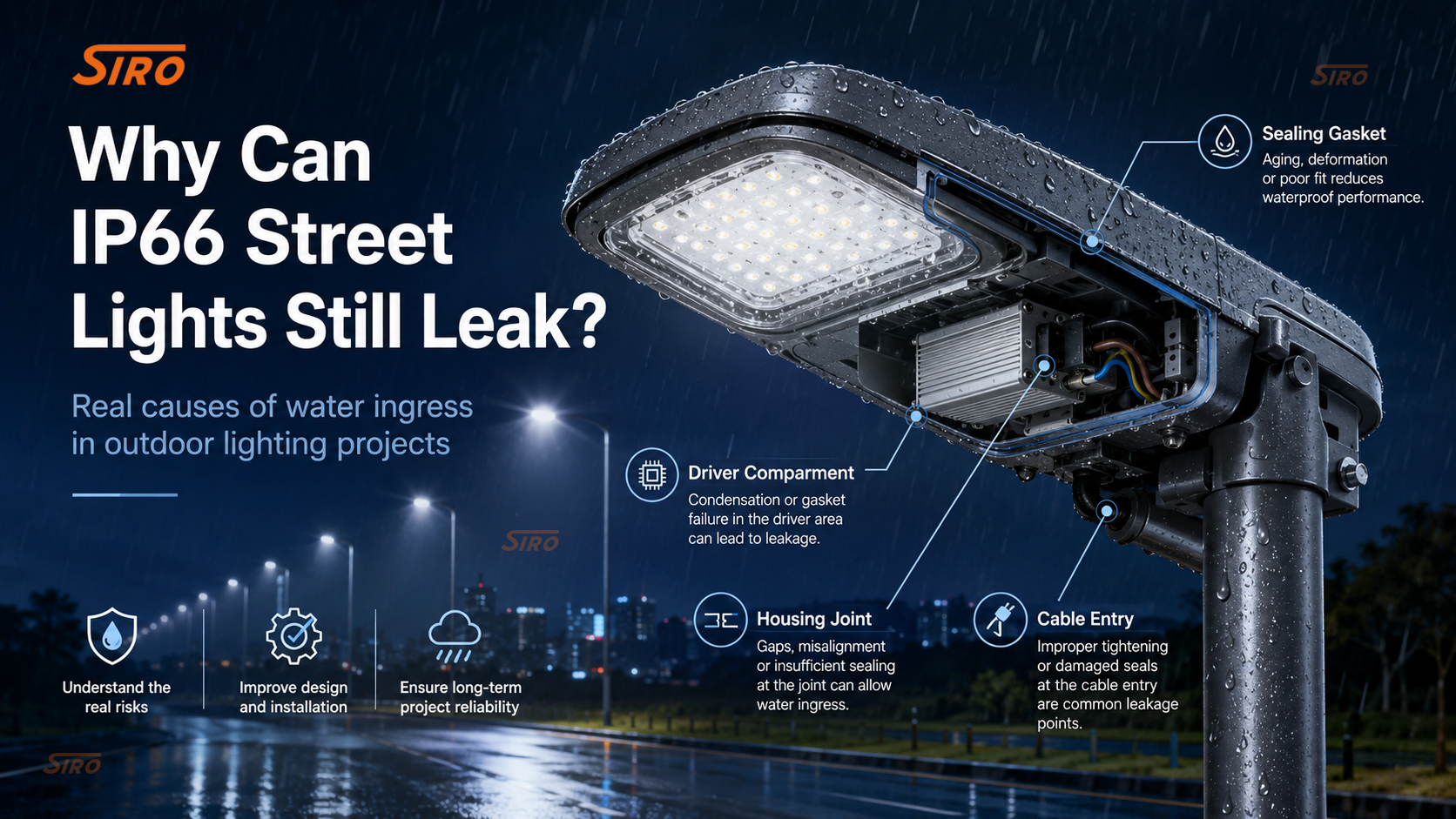
For example, the fixture may have too many joints, narrow sealing surfaces, uneven screw pressure, poor cable entry design, or no independent protection for the driver compartment.
These problems may not appear during a short test. But after months or years outdoors, rain, heat expansion, cold contraction, dust, and vibration can slowly create leakage risks.
Customers should pay special attention to these areas:
Housing Connection Area
The joint between the upper cover and lower housing must be flat, clean, and evenly compressed. If the sealing surface is not well designed, water may slowly enter through small gaps.
Lens or Glass Area
The optical part must be well sealed. If water vapor enters the LED module area, it may cause LED blackening, lumen depreciation, short circuit, or uneven lighting.
Driver Compartment
The LED driver is one of the most sensitive parts of a street light. Once water enters the driver compartment, the fixture may flicker, fail to turn on, trip the circuit, or stop working completely.
Cable Entry
The cable entry is often the most ignored area. A fixture may pass waterproof testing at the factory, but if the cable gland or wiring position is not properly protected on site, water may still enter.
A good LED street light structure is not designed only to pass a laboratory test. It must be designed for real outdoor road lighting projects.
3. Sealing Material and Assembly Quality Directly Affect Waterproof Performance
Many IP66 LED street light leakage problems are not caused by the absence of waterproof design. They are caused by poor sealing material or unstable assembly quality.
Common waterproof parts include silicone gaskets, sealing strips, waterproof glue, rubber rings, waterproof cable glands, and sealing pads.
Their long-term performance depends on:
- Material quality
- Temperature resistance
- UV resistance
- Compression recovery
- Aging resistance
- Correct installation position
If the sealing gasket is made from low-quality material, it may become hard, cracked, or lose elasticity after long outdoor use.
If the gasket is not correctly placed in the groove during assembly, one small raised point can create a leakage path.
If screws are not tightened evenly, some areas may be over-compressed while other areas are not compressed enough.
If dust, aluminum chips, wire skin, or small particles remain on the sealing surface, the waterproof performance may be reduced.
For customers, these details are difficult to see from product pictures. That is why supplier selection is important.
A reliable LED street light manufacturer should not only check whether the light can turn on. The factory should also check gasket position, screw tightening, cable entry sealing, waterproof structure, aging test results, and final inspection before shipment.
4. Installation and Wiring Are Common Causes of Water Leakage
In many real projects, the reported “street light leakage” is not always caused by the lamp body itself. Very often, the problem comes from installation or wiring.
Common site problems include:
- Cable joints without waterproof junction boxes
- Exposed wire terminals inside humid poles
- Cable entry facing upward
- Rainwater flowing along the cable into the fixture
- Damaged cable gland during installation
- Incorrect installation angle
- Water staying on the fixture surface for a long time
- The cover opened during maintenance but not sealed again
- Cable diameter not matching the cable gland
These situations are common in outdoor lighting projects.
Customers need to understand that waterproofing is a complete system. It includes the lamp body, cable, connector, junction box, pole, installation angle, and construction quality.
For example, waterproof cable glands are designed for specific cable diameter ranges. If the cable is too thin, the gland may not grip tightly even when it is fully tightened.
Another common issue is water migration along the cable. If the connection area is not sealed properly, moisture can travel through the cable route and enter the fixture.
For engineering customers, a good supplier should provide more than products. The supplier should also provide installation suggestions, wiring guidance, and after-sales technical support.
5. Condensation Is Not Always the Same as Water Leakage
Some customers see fog or moisture inside the lens and immediately think the lamp is leaking. In some cases, the problem may actually be condensation.
Outdoor LED street lights experience temperature changes every day. During the day, sunlight heats the fixture. At night, the temperature drops. When warm humid air inside the fixture cools down, moisture may condense on the lens or glass surface.
This is more common in:
- Coastal areas
- Rainy seasons
- Tropical climates
- High-humidity regions
- Areas with large day-night temperature differences
Condensation and leakage are different.
Light fog that appears for a short time and disappears after the lamp works or after the weather becomes dry is usually condensation.
But visible water drops, flowing water, accumulated water, rusty screws, corroded driver parts, or repeated electrical failure may indicate real water ingress.
To reduce condensation risk, professional outdoor LED lights may use waterproof breathable valves or breathable membranes. These components help balance air pressure inside and outside the fixture and reduce the suction effect caused by thermal expansion and contraction.
For projects in humid or coastal areas, customers should inform the supplier about the local environment before ordering. This helps the manufacturer recommend a more suitable waterproof and anti-corrosion solution.
6. Transportation Damage Can Break the Waterproof Structure
Transportation is another factor that many customers overlook.
LED street lights are usually made with aluminum housings. Although the housing is strong, serious impact, compression, or dropping during transportation may cause slight deformation.
Sometimes the damage is not obvious from the outside. But the sealing surface may already be affected. A small deformation at the housing edge, glass frame, or cover joint can reduce waterproof performance.
This is especially important for high-power street lights, modular street lights, or long-size fixtures.
After receiving the goods, customers should check:
- Whether the outer carton is seriously damaged
- Whether the housing corners are bent
- Whether the glass or lens is loose
- Whether the cable gland is complete
- Whether screws are loose
- Whether there are cracks on the fixture body
If clear transportation damage is found, the light should not be installed directly. It is better to check with the supplier first. Once a damaged lamp is installed on site, later troubleshooting will cost more time and labor.
7. Maintenance or Re-Opening May Reduce Waterproof Performance
A street light may meet the IP66 requirement when it leaves the factory. But after on-site repair or re-opening, the waterproof condition may change.
For example:
The driver compartment is opened for driver replacement.
The gasket is not put back into the correct position.
The screws are not tightened evenly.
Dust or sand remains on the sealing surface.
The original waterproof glue is damaged.
A waterproof cable gland is replaced with a normal connector.
The breathable valve is removed or blocked.
All these actions can reduce waterproof performance.
If maintenance is required, it should be done by trained workers according to the manufacturer’s instructions. After repair, the sealing structure must be restored carefully.
For manufacturers, product design should also consider maintenance convenience. Customers should be able to replace drivers or parts without easily damaging the waterproof system.
A good outdoor LED light should not only be reliable before shipment. It should also be practical for future maintenance.
8. Extremely Low Price Often Means Hidden Waterproof Risks
In overseas markets, price comparison is normal. Every customer wants competitive products. But for outdoor engineering lighting, an extremely low price may mean that some invisible but important details have been reduced.
For example:
- Cheaper sealing gasket material
- Thinner housing
- Lower-quality cable gland
- Simplified driver compartment
- Poor screw anti-corrosion treatment
- No full aging test
- No waterproof inspection
- Weak packaging protection
These cost reductions may not be obvious on the quotation sheet. But they can appear later as real project problems.
For contractors, distributors, and project companies, the most expensive part is not always the purchase price. It is the maintenance cost, labor cost, lifting equipment cost, customer complaint cost, and reputation loss.
If one street light fails due to water ingress, the customer may need to arrange workers, high-lift equipment, traffic control, rewiring, and replacement. In some projects, there may also be penalty costs or warranty pressure.
That is why customers should not choose LED street lights only by unit price. Long-term project cost is more important.
9. How Can Customers Judge Whether an IP66 LED Street Light Is Reliable?
From a customer’s point of view, a reliable IP66 LED street light should be checked from several aspects.
Check the Structure
Look at the housing joints, driver compartment, cable entry, optical module, and sealing design. A simple and stable structure usually has lower leakage risk.
Check the Materials
The housing should be strong enough for outdoor use. The gasket should have good aging resistance. Screws and metal parts should be suitable for humid and rainy environments.
Check the Assembly Quality
The gasket should be flat. Screws should be evenly tightened. Cable glands should be firm. The lens or glass should not be loose.
Check the Testing Process
Ask whether the supplier conducts aging tests, lighting tests, driver tests, waterproof checks, and final inspection before shipment.
Check the Technical Support
For project customers, IES files, installation instructions, wiring guidance, specification sheets, and after-sales support are very important.
Check the Supplier’s Project Experience
A factory with real project experience understands different climates, installation conditions, and customer pain points better. This can help reduce project risk.
A good supplier does not only sell lights. A good supplier helps customers avoid future problems.
10. How SIRO Light Helps Reduce Water Leakage Risk
SIRO Light focuses on outdoor engineering lighting products, including LED street lights, solar street lights, LED flood lights, high bay lights, garden lights, stadium flood lights, and tower crane lights.
For LED street lights, we pay close attention to:
- IP66 waterproof structure
- Stable sealing design
- Reliable driver compartment protection
- Efficient heat dissipation
- Outdoor cable entry protection
- Aging test before shipment
- Final inspection
- Project communication and technical support
We understand that customers do not buy street lights only for specifications. They buy them to complete projects, reduce after-sales problems, and protect their business reputation.
Before recommending a solution, we usually communicate with customers about pole height, road width, installation angle, local climate, coastal conditions, rainy season, voltage situation, and working hours. Based on this information, we can suggest a more suitable LED street light solution.
Conclusion: IP66 Is the Basic Requirement, Long-Term Reliability Is the Real Value
IP66 waterproof rating is important for LED street lights, but it is not the only factor. Water leakage can be caused by structure design, sealing material, assembly quality, transportation, installation, wiring, maintenance, and environmental conditions.
For customers, the key is not only to see the word “IP66” on the datasheet. The key is to work with a manufacturer that truly understands outdoor engineering lighting.
A good LED street light should withstand rain, dust, heat, long working hours, and real project conditions.
For road lighting projects, industrial parks, parking lots, municipal roads, and overseas distribution markets, reliable waterproof performance directly affects product lifetime, maintenance cost, and customer satisfaction.
If you are looking for a stable IP66 LED street light, solar street light, or other outdoor engineering lighting products, SIRO Light can support you with factory manufacturing, OEM/ODM service, IES files, technical documents, and project support.
Contact SIRO Light to get a reliable outdoor lighting solution for your next project.