Wrong Installation Can Destroy a Perfect Solar Street Light
Why Installation Quality Determines the Success of Solar Street Lighting Projects
When clients choose solar street lights, most of their attention goes to specifications—wattage, lumen output, solar panel size, battery capacity, and price. However, one of the most critical factors that determines whether a project succeeds or fails is often overlooked:
Installation quality.
In real-world projects, we frequently encounter cases where the product itself is not the issue. The solar panel, battery, controller, and LED system are all properly designed and manufactured—yet after installation, problems begin to appear:
- Insufficient lighting duration
- Uneven brightness across the road
- Poor charging performance
- System instability or repeated failures
- Structural misalignment or vibration
At first glance, these issues seem like product defects. But after technical analysis, the root cause is often clear:
Incorrect installation can destroy even a perfectly engineered solar street light system.
A solar street light is not just a lamp—it is a complete off-grid energy system that integrates solar generation, energy storage, intelligent control, lighting output, and structural design. Every installation detail directly affects system performance.
This article explores the most common and critical installation mistakes from a professional engineering perspective:
- Incorrect installation angle
- Shading issues (trees, buildings, obstacles)
- Improper pole height selection
- Poor grounding and electrical protection
Why Solar Street Lights Depend More on Installation Than Traditional Lighting
Unlike conventional LED street lights powered by the electrical grid, solar street lights operate on a daily energy cycle:
Daytime: solar charging → energy storage → Nighttime: controlled discharge for lighting
This means:
- Energy is limited, not continuous
- Charging efficiency directly affects nighttime performance
- System balance must be maintained over time
If installation reduces charging efficiency or introduces structural/electrical risks, the system will gradually fail:
- Reduced charging efficiency
- Shorter lighting duration
- Poor performance during rainy seasons
- Accelerated battery aging
- Increased maintenance costs
Many so-called “product failures” are actually installation failures in disguise.
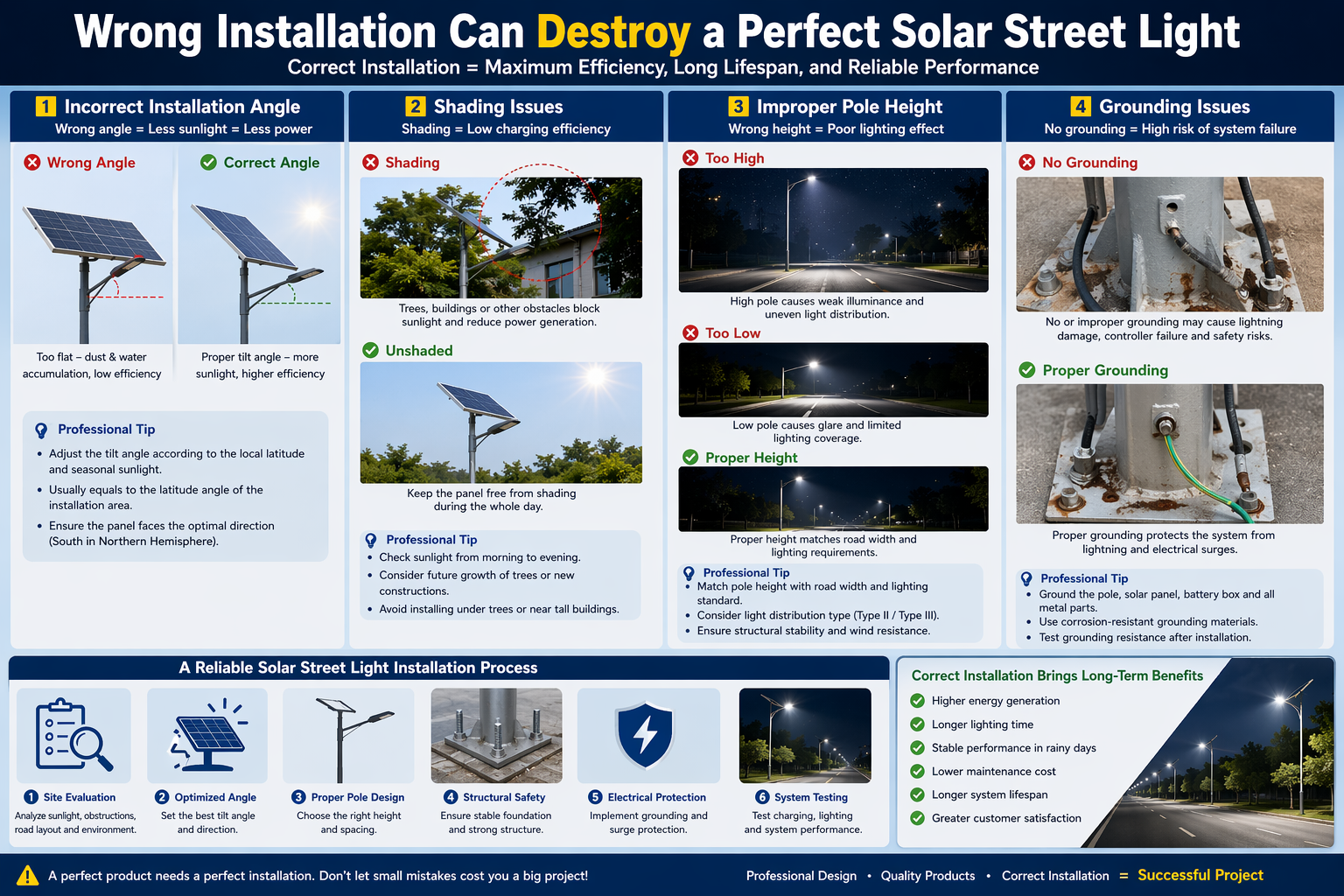
1. Incorrect Installation Angle: A Silent Performance Killer
Why Angle Matters
The tilt angle of the solar panel determines how much sunlight it can capture throughout the year. A poorly installed panel may still generate power—but at significantly reduced efficiency.
Common mistakes include:
- Panels installed too flat (causing dust and water accumulation)
- Incorrect tilt angle for local latitude
- Poor orientation (not facing optimal sunlight direction)
- Inconsistent angles across the same project
Real Impact
- Reduced daily energy generation
- Battery never fully charged
- Shorter lighting hours at night
- System entering low-power protection mode
Professional Insight
Solar panels must be installed based on geographical latitude and seasonal sunlight conditions, not guesswork. Even a small deviation can significantly impact long-term system stability.
2. Shading Issues: The Hidden Enemy of Solar Efficiency
Even partial shading can dramatically reduce solar panel output.
Common Sources of Shading
- Trees and vegetation
- Buildings and walls
- Billboards or infrastructure
- Future environmental growth
Why It’s Critical
Solar panels rely on continuous and unobstructed sunlight. Intermittent shading reduces effective charging hours, especially during peak sunlight periods.
Typical Consequences
- Inconsistent performance across installations
- Faster battery degradation
- Poor performance during cloudy or rainy days
- Customer complaints about “unstable quality”
Professional Recommendation
- Conduct site analysis before installation
- Avoid shaded areas throughout the day
- Consider future growth (trees, buildings)
- Evaluate sunlight exposure at different times (morning, noon, afternoon)
3. Improper Pole Height: Not Higher = Better
Many assume that a higher pole means better lighting coverage. In reality, pole height must match road width, spacing, and light distribution design.
If Pole Height Is Too High
- Reduced ground illuminance
- Light dispersion becomes too wide
- Poor lighting uniformity
If Pole Height Is Too Low
- Limited coverage area
- Increased glare
- Uneven lighting distribution
Structural Impact
Higher poles increase wind load and structural stress, which can lead to:
- Pole instability
- Vibration or deformation
- Safety risks in extreme weather
Engineering Recommendation
- Match pole height with road width and lighting requirements
- Combine with proper beam angle (Type II / Type III distribution)
- Ensure structural stability and wind resistance
4. Grounding Issues: The Most Underrated Risk
Many installers assume solar street lights don’t require grounding because they are off-grid systems. This is a critical misunderstanding.
Why Grounding Matters
Solar street lights are exposed to:
- Lightning surges
- Static electricity
- Voltage fluctuations
- Harsh outdoor environments
Without proper grounding:
- Controllers may fail prematurely
- LED drivers can be damaged
- System stability decreases
- Hidden electrical risks increase
Common Mistakes
- No grounding at all
- Poor-quality grounding connections
- Corroded or loose connections
- Lack of system-wide grounding integration
Professional Recommendation
- Always include grounding in system design
- Ensure proper connection between metal structures and electrical components
- Use corrosion-resistant materials
- Test grounding effectiveness after installation
Why Installation Problems Are Often Misjudged as Product Failures
This is one of the most common misunderstandings in the industry.
| Observed Problem | Assumed Cause | Actual Cause |
| Short lighting time | Battery issue | Poor solar charging (angle/shading) |
| Some lights not working | Product inconsistency | Local installation conditions |
| Weak performance in rainy season | Low-quality system | Insufficient energy generation |
| Uneven lighting | Poor LED quality | Incorrect pole height/design |
| Failures after storms | Weak components | Lack of grounding |
What Defines a Reliable Solar Street Light Installation?
A professional installation process should include:
1. Site Evaluation
Analyze sunlight conditions, obstacles, road layout, and environmental factors.
2. Optimized Panel Angle
Design based on geographic location and solar path.
3. Proper Pole Design
Match height, spacing, and lighting requirements.
4. Structural Safety
Ensure stable foundation, correct alignment, and wind resistance.
5. Electrical Protection
Implement proper grounding and surge protection.
6. Final System Testing
Verify charging, lighting performance, and structural stability.
Conclusion: Installation Is Not the Final Step—It’s the Deciding Factor
A solar street light system is only as good as its installation.
Incorrect angle wastes solar energy.
Shading reduces charging efficiency.
Improper pole height destroys lighting performance.
Poor grounding introduces hidden electrical risks.
The difference between a short-term solution and a long-term reliable project lies in installation quality.
A truly professional solar lighting solution is not just about specifications—it’s about how the system performs in real outdoor conditions over time.