Why Are Street Lights Not Bright Enough After Installation?
For many road lighting projects, one of the most common problems is that the street lights do not look bright enough after installation. Some customers immediately think the lamp wattage is too low, or the LED chips are not powerful enough.
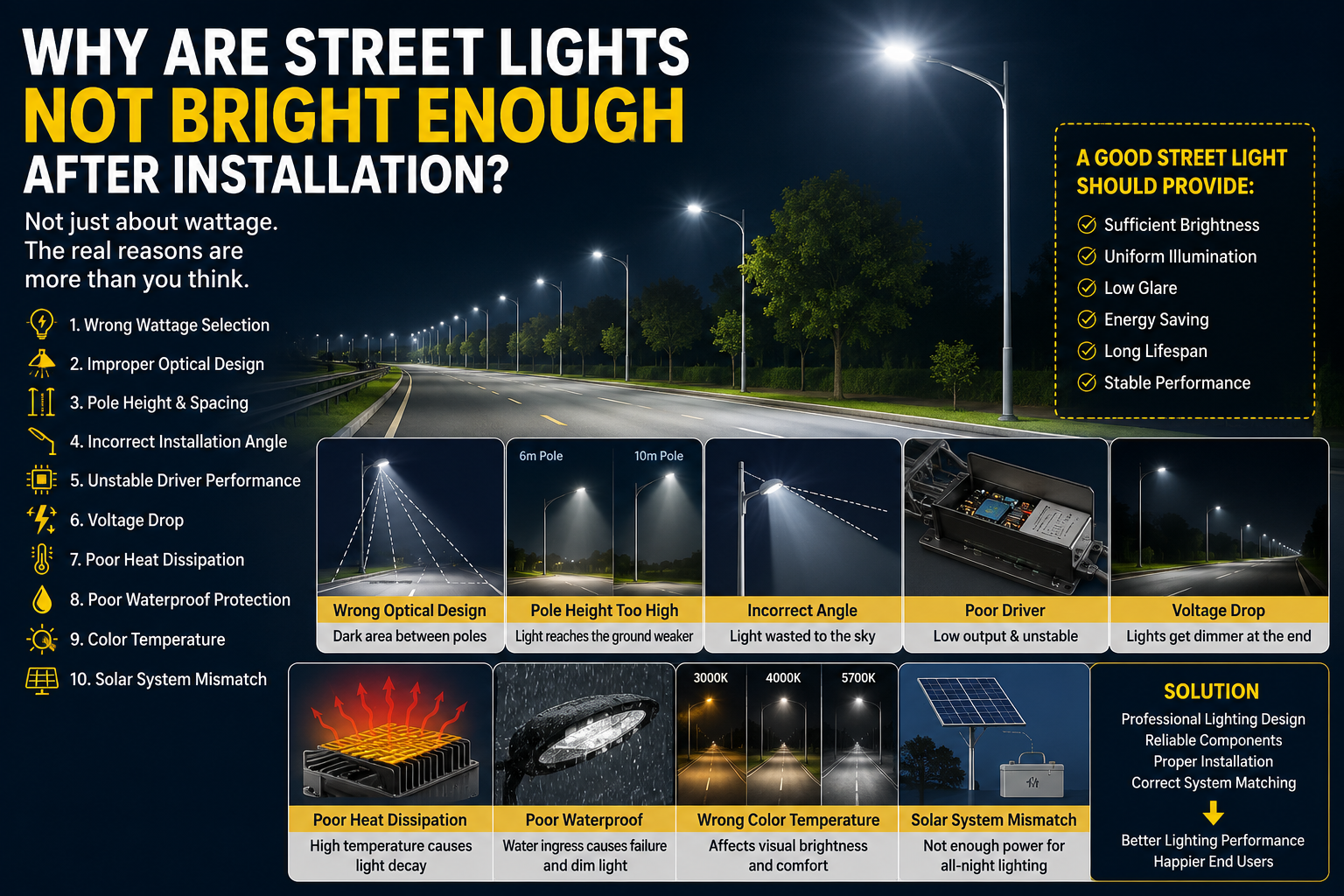
However, in real engineering projects, brightness is not decided by wattage alone. A street light may look dim because of many factors, such as optical design, pole height, pole spacing, installation angle, driver performance, voltage drop, heat dissipation, waterproof structure, color temperature, and project layout.
For municipal roads, industrial parks, parking lots, rural roads, residential areas, and commercial outdoor lighting projects, the key question is not only “How many watts is the lamp?” The real question should be: “Is the light correctly designed for this road?”
1. Wattage Is Not the Only Standard
Many buyers choose LED street lights by wattage first. For example, they may ask for 100W, 150W, or 200W street lights. But wattage only shows power consumption. It does not fully represent the actual lighting performance.
Two 150W LED street lights from different manufacturers may have very different results. The LED chips, driver, lens, heat dissipation structure, and total lumen output can all affect the final brightness.
Sometimes, a high-efficiency 120W LED street light with good optical design can perform better than a low-quality 150W model. That is why project buyers should not only compare wattage. They should also check lumen output, luminous efficiency, beam angle, IES files, and real road lighting performance.
2. Wrong Optical Design Can Cause Dark Areas
Street lighting is different from normal flood lighting. A road light must distribute light evenly on the road surface. It should not only create a bright spot under the pole while leaving dark areas between two poles.
If the optical design is not suitable, several problems may appear:
The area under the pole is bright, but the middle area between poles is dark.
The center of the road is bright, but the road edge is not clear.
Light is wasted outside the road.
The lamp looks glaring, but the road surface is still not bright enough.
This problem is usually caused by the wrong lens or beam distribution, not simply by low wattage. A professional LED street light should match the road width, pole height, pole distance, and installation method.
For engineering projects, IES files are very important. With IES lighting simulation, customers can check the average illumination, uniformity, dark areas, and lighting coverage before installation. This helps reduce the risk of poor lighting results after the project is completed.
3. Pole Height and Pole Distance Are Not Suitable
Pole height and pole spacing directly affect road brightness.
If the pole is too high but the lamp power or beam angle is not suitable, the light reaching the ground will become weaker. If the distance between poles is too long, the middle area may become dark. If the road is wide but the lamps are installed only on one side, the far side of the road may not receive enough light.
For example, the same 100W LED street light will look very different when installed on a 6-meter pole and a 10-meter pole. A lamp that works well at 6 meters may not be suitable for a higher pole.
Before choosing a street light, buyers should confirm the road width, pole height, pole spacing, arm length, installation angle, and whether the lamps are installed on one side, both sides, or in a staggered layout.
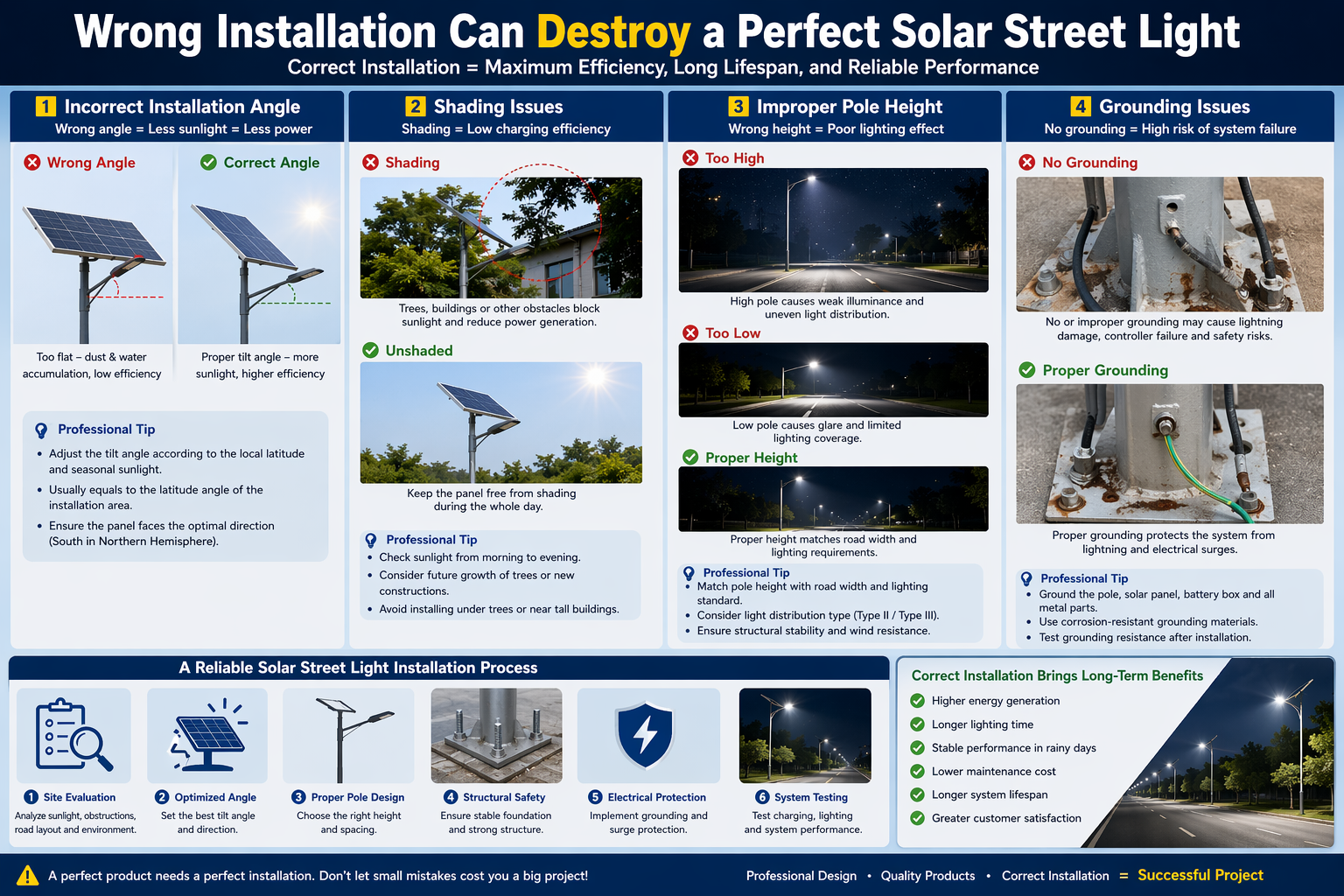
4. Incorrect Installation Angle Affects Lighting Coverage
The installation angle may look like a small detail, but it has a big impact on the lighting effect.
If the lamp angle is too high, much of the light may go into the distance or into the sky. This causes light loss and increases glare. If the angle is too low, the area near the pole may be very bright, but the lighting coverage becomes limited.
In some projects, installers adjust the lamp head upward because they want the light to “shine farther.” But this may reduce the effective illumination on the road surface.
Correct installation should make the light cover the main driving area and pedestrian area, while reducing glare and wasted light.
5. Unstable LED Driver May Reduce Actual Output
The LED driver is one of the most important components in a street light. It controls the power supply to the LED chips. If the driver quality is poor or the actual output is not stable, the street light may not reach its designed brightness.
Low-quality drivers may cause flickering, low output power, early failure, overheating, or unstable performance. In outdoor road lighting projects, the driver should support stable current output, surge protection, wide voltage input, and long working hours.
This is especially important in areas with unstable voltage, long-distance wiring, industrial parks, rural roads, and high-temperature environments.
6. Voltage Drop Can Make Street Lights Dimmer
Sometimes the lamps are good, but the lights at the end of the line are dimmer than the lights near the power source. This may be caused by voltage drop.
When the cable is too long, the wire size is too small, or there are too many connection points, the voltage at the end of the line may become lower. Even if the LED driver supports a wide voltage range, long-term low input voltage may still affect brightness and stability.
For large road lighting projects, the electrical design should be checked together with the lighting design. Cable size, circuit layout, power supply distance, and connection quality can all influence the final lighting result.
7. Poor Heat Dissipation Causes Light Decay
Some street lights look acceptable at the beginning, but become dimmer after several months of use. One common reason is poor heat dissipation.
LED chips and drivers produce heat during operation. If the lamp body cannot release heat efficiently, the internal temperature will stay high. This can accelerate lumen depreciation and reduce the lifespan of the LED chips and driver.
A reliable LED street light usually uses die-casting aluminum housing and a well-designed heat sink structure. Good heat dissipation helps maintain stable brightness during long working hours, especially in hot climates and high-power outdoor lighting projects.
8. Poor Waterproof Structure Can Affect Brightness and Lifespan
Street lights work outdoors for many years. They must face rain, dust, humidity, wind, and temperature changes. If the waterproof structure is poor, water or moisture may enter the lamp body and damage the LED board or driver.
IP66 waterproof protection is a common and important requirement for outdoor LED street lights. A reliable IP66 street light should have a strong housing, good sealing design, protected cable entry, and stable assembly quality.
Water ingress may cause corrosion, short circuits, lower brightness, flickering, or complete lamp failure. For road lighting projects, waterproof performance should not be ignored.
9. Color Temperature Also Affects Visual Brightness
Sometimes customers feel the street light is not bright enough, but the real illumination level may be acceptable. The issue may come from color temperature.
Cool white light often looks brighter and clearer to the human eye. Warm white light looks softer, but some users may feel it is not bright enough. Common street lighting color temperatures include 3000K, 4000K, 5000K, 5700K, and 6500K.
For main roads and industrial areas, many projects choose 4000K to 5700K for better visibility. For residential areas, parks, or landscape roads, warmer light may be preferred for comfort.
The best color temperature depends on the project application, local standard, road environment, and customer preference.
10. Solar Street Lights Need System Matching
If solar street lights are not bright enough after installation, the problem may not only be the lamp. The solar panel, battery capacity, controller setting, local sunshine hours, and working mode must also be checked.
Many solar street lights use time-control or motion-sensor dimming modes. For example, the lamp may work at 100% brightness for the first few hours and then reduce to 50% or 30% brightness later at night. If customers do not know the setting, they may think the lamp is not bright enough.
Solar street light projects should match the lamp power, solar panel, battery, controller, installation angle, and local weather conditions. A complete system design is necessary for stable night lighting.
How to Avoid Poor Brightness After Installation
To avoid poor lighting results, customers should provide complete project information before ordering, including road width, pole height, pole spacing, installation layout, voltage condition, required brightness, and site photos.
A professional LED street light manufacturer can recommend suitable wattage, beam angle, driver configuration, and installation solution based on real project data. IES files and lighting simulation can also help predict the lighting effect before installation.
For contractors, distributors, and project buyers, choosing a street light supplier should not only be about price. Product structure, driver quality, IP66 waterproof design, heat dissipation, IES testing, aging test, and after-sales support are all important for long-term project reliability.
Conclusion
If street lights are not bright enough after installation, the reason is not always low wattage. The real problem may be optical design, pole height, pole distance, installation angle, voltage drop, driver quality, heat dissipation, waterproof performance, color temperature, or solar system matching.
A successful road lighting project needs more than a high-power lamp. It needs a professional lighting solution.
SIRO Light focuses on LED street lights, solar street lights, LED flood lights, high bay lights, garden lights, stadium flood lights, and tower crane lights. We support OEM/ODM customization, IP66 waterproof design, stable driver solutions, IES testing, aging testing, and project-based lighting recommendations.
If you are worried that your street lights may not be bright enough after installation, please send us your road width, pole height, pole spacing, installation layout, and site photos. Our team can help you choose a more suitable LED street lighting solution for your project.