
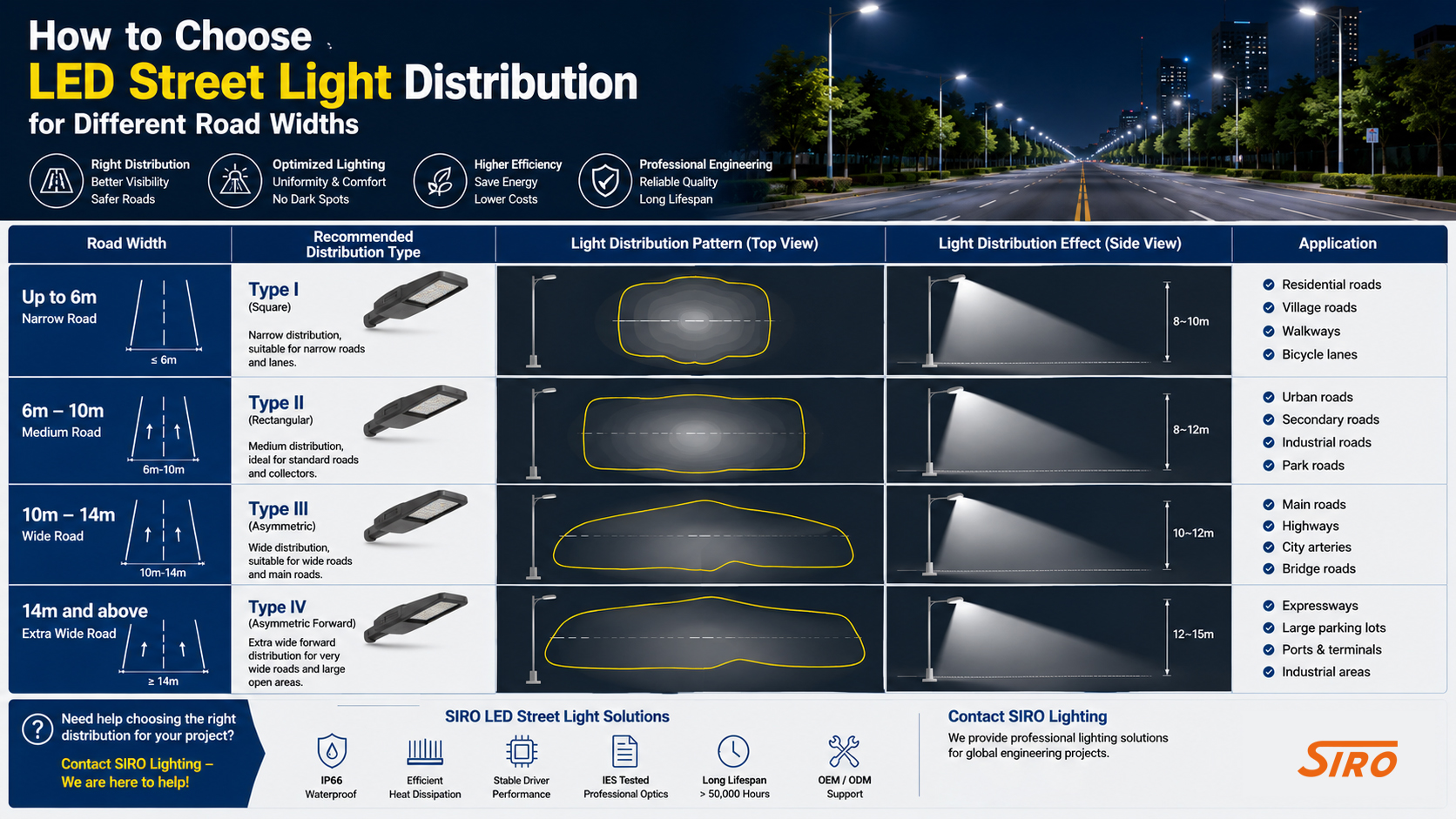
How to Choose LED Street Light Distribution for Different Road Widths
Choosing an LED street light only by wattage or lumen output is a common mistake in roadway lighting projects. A 100W luminaire may perform well on one road but create dark areas, excessive glare or wasted light on another.
The reason is simple: road width, pole height, pole position and optical distribution must work together.
For a professional road lighting design, the first question should not be “How many watts do we need?” It should be “Where should the light be distributed?”
What Is LED Street Light Distribution?
LED street light distribution describes how the luminaire directs light across and along the roadway. The most commonly used roadway optics are Type II, Type III and Type IV. Type V is mainly used for open or symmetrical areas.
The correct optic helps improve:
- Road surface uniformity
- Visibility of vehicles and pedestrians
- Pole spacing efficiency
- Glare control
- Energy utilization
- Control of light spill outside the road
Road width is important, but it should always be considered together with mounting height.
Type II: Suitable for Narrow Roads
Type II distribution provides a relatively narrow lateral spread with longer light coverage along the road.
It is commonly used for:
- Residential streets
- Rural roads
- Bicycle lanes
- Narrow access roads
- One- or two-lane roads
As a preliminary rule, Type II can be considered when the effective road width is similar to or smaller than the mounting height.
For example, a road approximately 6–8 meters wide may use poles with a mounting height of 7–9 meters. Type II optics can help keep most of the light on the carriageway instead of sending unnecessary light behind the pole.
However, pole spacing must still be checked. Excessive spacing may create alternating bright and dark sections.
Type III: A Practical Choice for Medium-Width Roads
Type III distribution has a wider lateral beam than Type II and is one of the most commonly used optics for urban road projects.
Typical applications include:
- Two- to four-lane urban roads
- Industrial park roads
- Main residential roads
- Municipal streets
- Roads with staggered or opposite pole layouts
Type III is often suitable when the road width is approximately equal to, or moderately greater than, the pole mounting height.
For an 8–12 meter road, Type III optics can provide better coverage toward the center of the roadway. When the road becomes wider, staggered or opposite-side installation may produce better uniformity than increasing luminaire power.
Type IV: For Wide Roads and Forward-Throw Applications
Type IV distribution pushes more light forward from the pole position. It is useful when the luminaire is installed near the edge of a wide road or set back behind a sidewalk.
It may be considered for:
- Wide arterial roads
- Multi-lane roads
- Roads with large pole setbacks
- Perimeter lighting
- One-side installations requiring deeper coverage
Type IV can reach farther across the road, but it must be selected carefully. A very strong forward beam may increase glare, create excessive brightness near the opposite side or reduce uniformity between poles.
For roads wider than approximately 1.5 times the mounting height, changing the pole arrangement is often more effective than relying only on a wider optic.
When Should Type V Be Used?
Type V produces a more symmetrical light pattern. It is generally not the first choice for long, linear roads.
It is more suitable for:
- Intersections
- Roundabouts
- Public squares
- Parking areas
- Large open spaces
Using Type V optics on a normal straight road may send too much light outside the required roadway area.
Road Width Is Not the Only Design Factor
Before confirming the LED street light optic, engineers should also check:
- Pole mounting height and spacing
- Single-side, staggered, opposite or median layout
- Number of lanes and road classification
- Pole setback and outreach arm length
- Required illuminance, luminance and uniformity
- Glare limits and surrounding residential areas
- Pavement reflection characteristics
Two luminaires labeled “Type III” may still produce different results because their lenses, peak intensity angles and beam control are not identical.
Why IES Lighting Simulation Is Necessary
The most reliable method is to build a lighting simulation using the actual project dimensions and the luminaire’s IES photometric file.
A simulation can show average illumination, minimum illumination, uniformity, glare risk and dark areas before installation. This prevents costly changes after poles and luminaires have already been installed.
At SIRO Light, we provide LED street lights with multiple optical lens options, IES files and project-based lighting simulation support. Our products are designed with IP66 protection, efficient thermal management, stable LED drivers and strict aging tests for reliable outdoor operation.
FAQ
Is Type III always better for a wider road?
No. A wider beam does not automatically mean better lighting. Pole height, spacing, setback and installation layout must also be considered.
Can higher wattage solve insufficient road coverage?
Not necessarily. Higher wattage may increase brightness without improving uniformity. Selecting the correct optic is usually more important.
What information is needed for a street lighting proposal?
Please provide the road width, road length, pole height, pole spacing, installation layout, number of lanes and required lighting standard.
Get a Professional Road Lighting Solution
Send SIRO Light your road drawing or project dimensions. Our engineering team can recommend the appropriate wattage, optical distribution, pole layout and IES simulation for your LED street lighting project.