Why Do Solar Street Lights Stop Working During Consecutive Rainy Days?
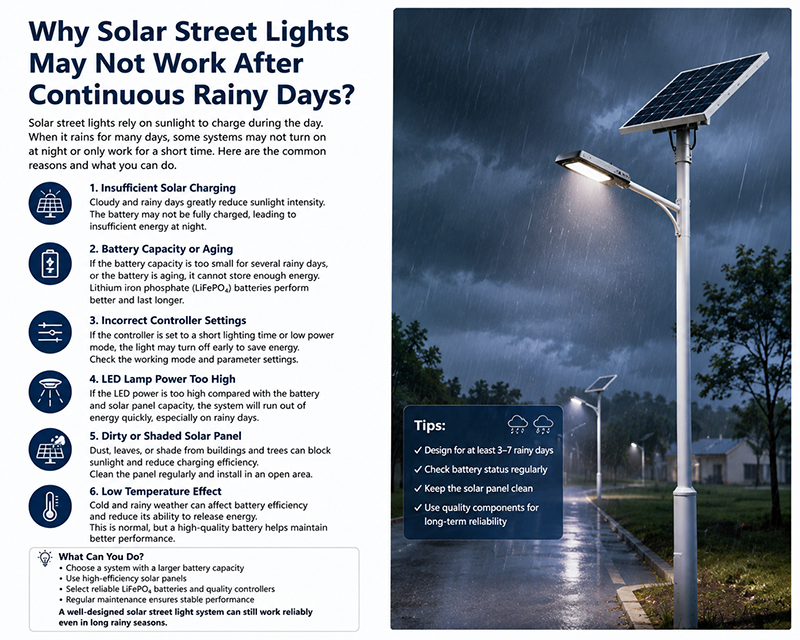
A common problem in outdoor solar lighting projects is that the solar street light works normally in sunny weather but stops lighting after several consecutive cloudy or rainy days.
This does not always mean the lamp is defective. In many cases, the real problem comes from insufficient system configuration, battery capacity, solar charging efficiency, or incorrect controller settings.
For contractors, distributors, and project owners, understanding these causes is important before selecting a solar street lighting solution.
1. The Battery Capacity Is Too Small
The battery is the energy storage center of a solar street light.
During sunny days, the solar panel charges the battery and stores enough energy for nighttime operation. However, during continuous rain, solar charging becomes much weaker.
If the battery capacity is designed only for one normal night instead of several low-sunlight days, the stored energy can quickly run out.
For engineering projects, battery capacity should be calculated according to:
- LED lamp power
- Daily lighting hours
- Local peak sun hours
- Required rainy-day autonomy
- Battery discharge depth
- Seasonal weather conditions
A properly designed system should consider the worst operating conditions, not only ideal sunny days.
2. The Solar Panel Cannot Generate Enough Energy
Solar panels can still generate electricity under cloudy conditions, but the output is significantly lower than under direct sunlight.
If the solar panel wattage is too small, the energy collected during rainy weather may not be enough to compensate for the electricity consumed every night.
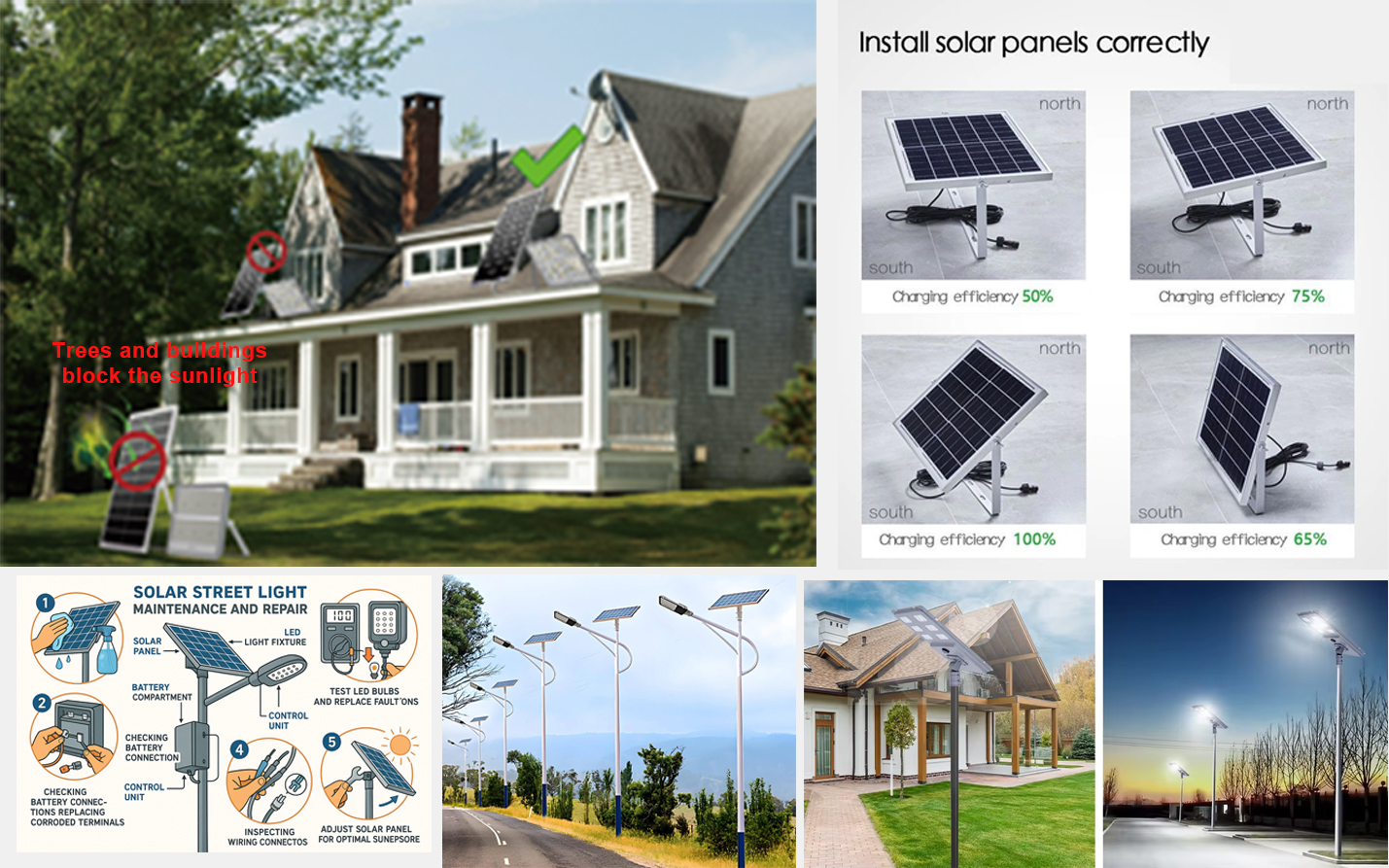
Another common issue is incorrect panel installation. Trees, buildings, poles, dust, or an unsuitable installation angle can reduce charging efficiency further.
For this reason, solar panel power should include a reasonable engineering margin, especially for regions with long rainy seasons or low winter solar radiation.
3. Battery Performance Has Decreased
Battery aging is another major reason why a solar street light may fail during consecutive rainy days.
As batteries age, their actual usable capacity gradually decreases. A battery that originally supported two or three nights may eventually support only one night.
High temperatures, excessive discharge, poor-quality battery cells, and unstable charging management can accelerate battery degradation.
When troubleshooting, engineers should check the battery voltage, actual capacity, charging condition, and cycle performance instead of replacing the LED lamp immediately.
4. Controller Settings Are Not Optimized
The solar controller determines how the system charges, discharges, and protects the battery.
If the lighting program is configured at full power for the entire night, energy consumption may be too high during periods of low solar input.
A better solution is intelligent power management.
For example, the lamp can operate at higher brightness during peak traffic hours and automatically reduce power after midnight. This helps extend operating time without significantly affecting road lighting performance.
Low-voltage protection is also important. When the battery reaches a minimum voltage, the controller may switch off the lamp to protect the battery from deep discharge.
Therefore, a light turning off can sometimes indicate that the protection system is working correctly.
5. The System Was Not Designed for Local Weather
One of the most important factors in solar street lighting is project-specific system design.
The same solar street light configuration should not be used in every country or every project.
A system installed in a high-sunlight region may perform very differently in an area with frequent rain, short winter days, or low solar radiation.
Before production, professional suppliers should evaluate installation location, road type, lighting hours, required autonomy, solar radiation data, and expected seasonal conditions.
How to Improve Solar Street Light Performance During Rainy Days
To improve system reliability, project buyers should focus on the complete lighting system rather than only LED wattage.
A reliable solution normally requires a properly sized solar panel, sufficient battery capacity, efficient LED modules, intelligent controller programming, stable waterproof construction, and suitable installation conditions.
At SIRO Light, we support solar street lighting projects with configuration recommendations based on actual application requirements. OEM and ODM options are also available for different road projects, lighting programs, battery capacities, and solar panel specifications.
FAQ
How many rainy days should a solar street light support?
It depends on the project. Many systems are designed for multiple days of autonomy, but the correct configuration should be calculated according to local weather and lighting requirements.
Can a solar street light charge on cloudy days?
Yes. Solar panels can generate electricity under cloudy conditions, but the charging efficiency is much lower than during strong sunlight.
Why does the light work again after a sunny day?
This usually means the battery was previously discharged and received sufficient energy after sunlight returned. It may indicate that the system’s energy storage or solar panel capacity is insufficient for consecutive rainy days.
Conclusion
When a solar street light stops working during continuous rainy weather, the cause is usually related to energy balance rather than the LED lamp itself.
Battery capacity, solar panel wattage, battery condition, controller settings, local solar radiation, and lighting hours must all be considered together.
For contractors and distributors, choosing a professionally configured solar street lighting system can reduce maintenance problems and improve long-term project reliability.
Need a solar street light configuration for your project? Contact SIRO Light with your installation height, required wattage, lighting hours, and project location. Our team can recommend a suitable solar panel, battery, and controller solution for your application.