
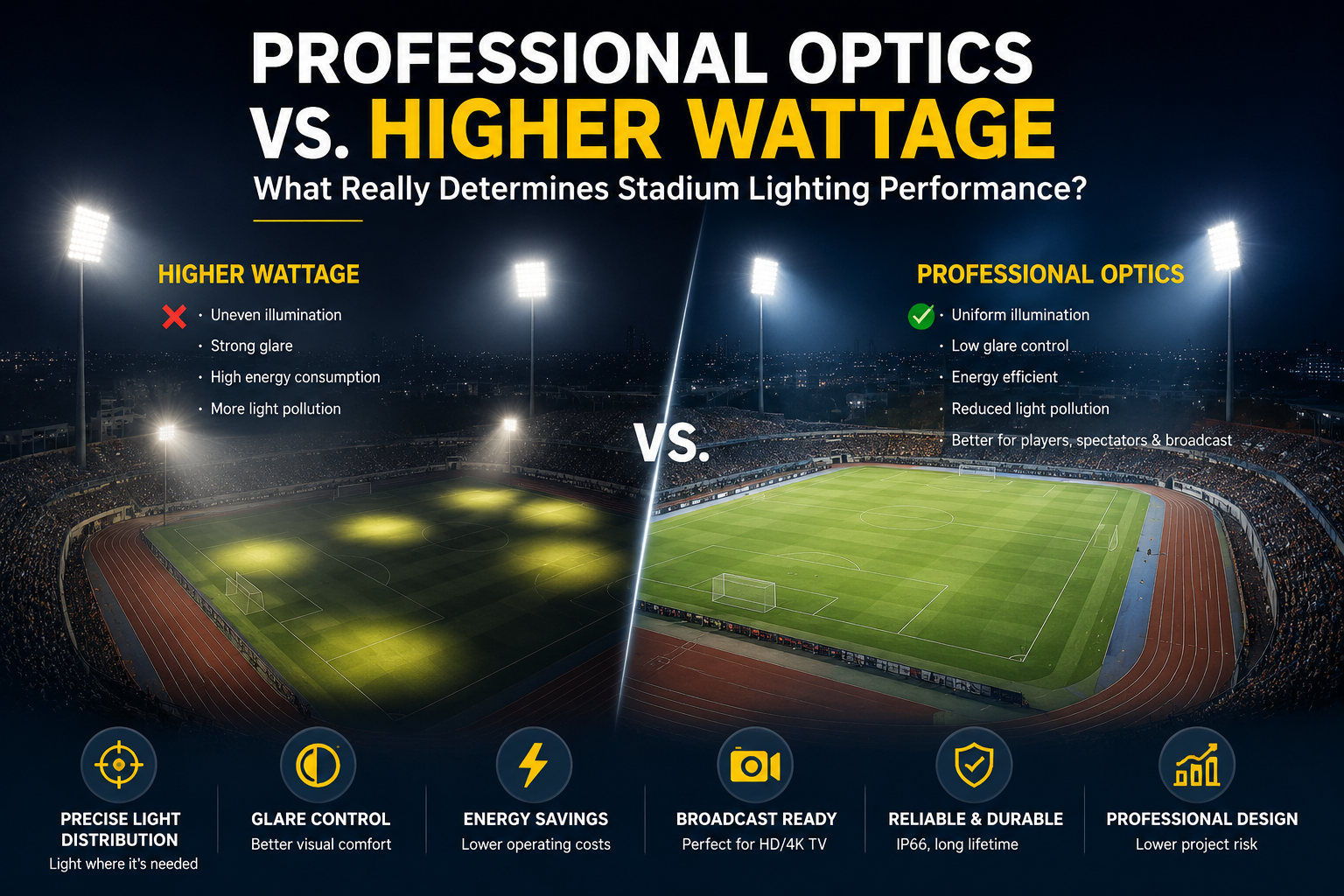
Why Stadium Floodlights Need Professional Light Distribution, Not Just Higher Wattage
When a sports field does not appear bright enough, the first reaction is often to increase the wattage of the stadium floodlights. However, higher power does not automatically create better lighting.
For professional stadium lighting projects, the real question is not how many watts a fixture consumes, but how effectively the light is delivered to the target area.
A 1,500W floodlight with unsuitable optics may create excessive brightness near the poles while leaving dark areas in the center of the field. In contrast, a properly designed 1,000W LED stadium floodlight can often achieve better illumination, higher uniformity, lower glare, and reduced energy consumption.
This is why professional light distribution is one of the most important factors in stadium lighting design.
Higher Wattage Does Not Guarantee Higher Usable Illuminance
Wattage only represents power consumption. It does not directly indicate how much useful light reaches the playing surface.
The final lighting result depends on several factors:
- Fixture luminous efficacy
- Beam angle
- Optical lens design
- Installation height
- Pole position
- Aiming angle
- Distance from the fixture to the target area
- Light loss caused by spill light
If the beam is too wide, a large amount of light may fall outside the stadium. If the beam is too narrow, the lighting may create bright spots and shadows.
For customers, this means that simply buying a higher-wattage stadium floodlight may increase electricity costs without solving the actual lighting problem.
Professional Optics Improve Lighting Uniformity
Uniformity is one of the most important indicators in a sports lighting project.
Players need consistent visibility across the entire field. Sudden changes between bright and dark areas can affect their ability to judge ball speed, distance, movement, and position.
Spectators and cameras also require stable lighting conditions.
Professional stadium floodlights normally use different optical distributions for different positions. Fixtures installed near the corners, sidelines, or behind the goals may require different beam angles.
Narrow beams are often used for long-distance projection, while medium or asymmetric beams help cover nearby and side areas.
By combining several beam distributions, lighting designers can achieve:
- Higher average illuminance
- Better minimum illuminance
- Improved uniformity
- Fewer dark zones
- Reduced overlapping hot spots
This cannot be achieved by wattage alone.
Glare Control Is a Major Customer Concern
Excessive glare is a common problem in poorly designed stadium lighting systems.
When the fixture angle is incorrect or the optical system lacks precise control, intense light may enter the eyes of players, referees, spectators, nearby residents, and drivers.
Increasing wattage can make this problem even worse.
Professional optical design controls the direction of light and reduces unnecessary upward or sideways light. Proper visor design, lens selection, fixture positioning, and aiming calculations can significantly reduce direct glare.
For stadium owners, better glare control means:
- Improved player comfort
- Better visual performance
- Fewer complaints from surrounding communities
- Reduced light pollution
- Better compliance with project requirements
Correct Light Distribution Reduces Energy Costs
Energy consumption is a long-term operating cost for stadiums.
If the optical distribution is inefficient, the project may require more fixtures or higher wattage to reach the required lux level. This increases electricity use, cable load, control system capacity, and maintenance expenses.
A professionally designed lighting solution directs more lumens onto the useful area. As a result, the project may achieve the target illuminance with fewer fixtures or lower total installed power.
For large stadiums that operate frequently, this difference can create substantial savings over the lifetime of the lighting system.
Customers should therefore compare total system efficiency rather than only fixture wattage.
Broadcast and High-Speed Cameras Require Better Lighting Quality
For stadiums used for professional competitions or television broadcasting, brightness alone is not enough.
High-speed cameras require stable vertical illumination, good uniformity, accurate color rendering, and flicker-free performance.
Poor light distribution may cause faces, balls, and moving objects to appear uneven or unclear on camera. Excessive contrast between different areas can also reduce broadcast image quality.
A professional stadium lighting design should evaluate both horizontal and vertical illuminance. It should also consider camera positions, player movement, viewing directions, and competition standards.
This requires IES photometric files, lighting simulation, precise aiming data, and reliable LED drivers. Simply increasing fixture power cannot solve these technical requirements.
Professional Lighting Design Reduces Project Risk
Before production or installation, a reliable stadium floodlight supplier should provide a lighting simulation based on the actual project information.
Important data normally includes:
- Field dimensions
- Pole height and location
- Required lux level
- Uniformity target
- Competition level
- Camera requirements
- Environmental conditions
- Local glare or spill-light limits
Using professional lighting software and accurate IES files, engineers can predict illuminance, uniformity, glare, and fixture quantity before installation.
This helps customers avoid common problems such as insufficient lux, excessive power consumption, incorrect beam angles, repeated installation adjustments, and costly fixture replacement.
What Customers Should Check Before Choosing Stadium Floodlights
When selecting an LED stadium floodlight, customers should not focus only on wattage and price.
A reliable solution should include:
- Multiple professional beam-angle options
- Accurate IES photometric reports
- Project lighting simulation
- High-efficiency optical lenses
- Stable, flicker-free LED drivers
- Effective heat dissipation
- IP66 weather protection
- Strong surge protection
- Aging tests before shipment
- Clear aiming and installation guidance
The supplier should also have experience in sports field lighting projects and be able to recommend suitable optics based on pole height, projection distance, and required lighting standards.
Conclusion
Professional stadium lighting is an optical engineering project, not a simple wattage comparison.
Higher power may increase total brightness, but it cannot automatically improve uniformity, reduce glare, control spill light, support broadcasting, or lower operating costs.
The best stadium floodlight solution uses the correct combination of fixture efficiency, beam distribution, installation position, aiming angle, and lighting calculation.
For project owners, contractors, and distributors, choosing a manufacturer with professional optical design and lighting simulation capabilities can reduce project risk and deliver better long-term value.
Frequently Asked Questions
Is a higher-wattage stadium floodlight always brighter?
It may produce more total lumens, but this does not mean more light will reach the required area. Beam distribution and installation design determine the usable illuminance.
Why are different beam angles used in one stadium?
Different fixture positions have different projection distances and coverage requirements. Combining narrow, medium, and asymmetric beams improves overall uniformity.
Can lighting simulation reduce installation problems?
Yes. A professional simulation can predict lux levels, dark areas, glare, fixture quantity, and aiming angles before installation.
What information is needed for a stadium lighting proposal?
The supplier normally needs the field dimensions, pole layout, mounting height, target lux level, uniformity requirement, competition level, and project drawings.
Need a Professional Stadium Lighting Solution?
SIRO Light provides LED stadium floodlights, professional optical options, IES files, lighting simulations, OEM/ODM support, and project-based technical guidance.
Send us your field dimensions, pole layout, mounting height, and target lux level. Our engineering team will help you develop a more efficient and reliable stadium lighting solution.