5-Year Warranty for LED Luminaires: What Conditions Should Customers Confirm?
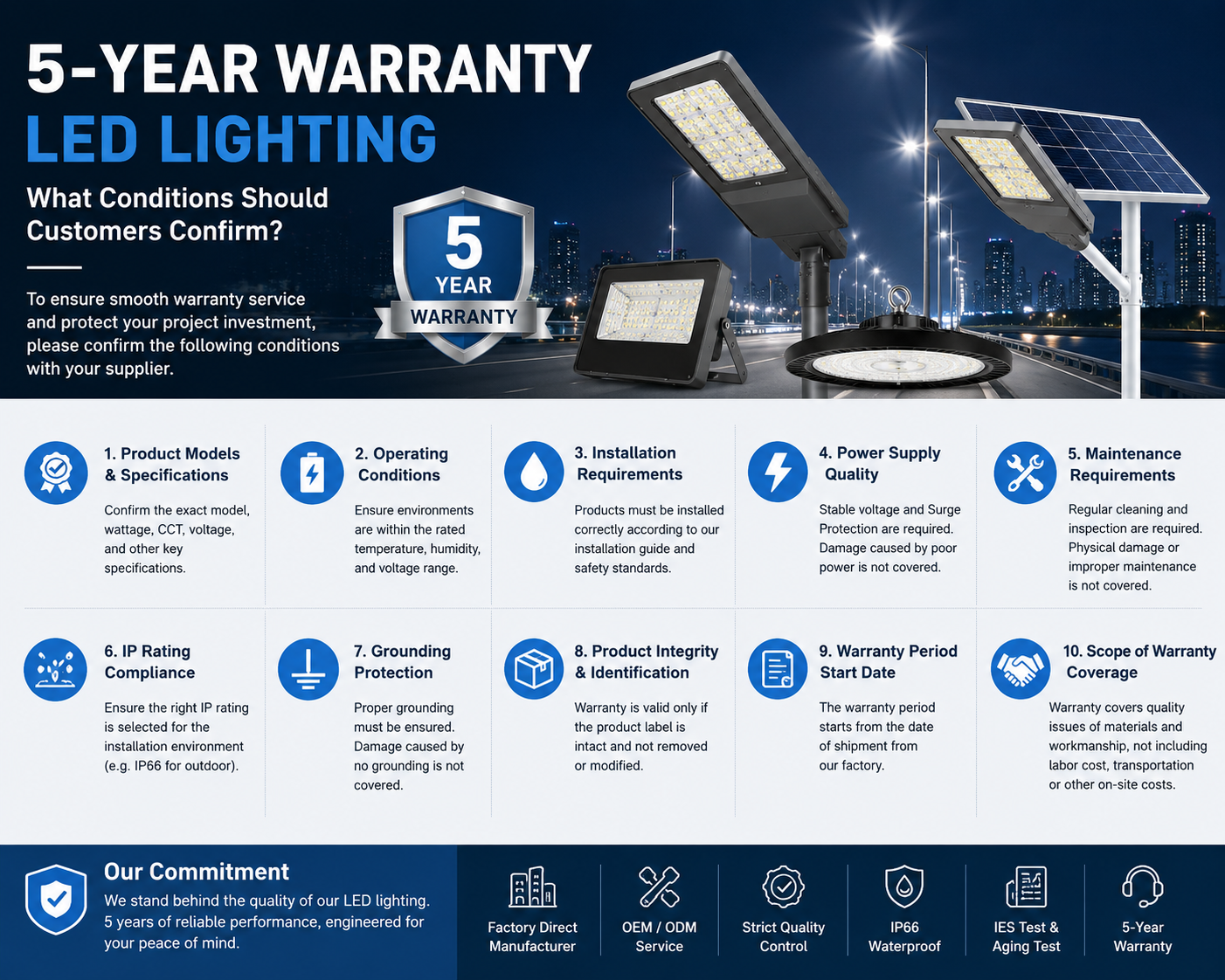
A 5-year warranty is now a common selling point in the LED lighting industry. However, for distributors, contractors, and project buyers, the real value of a warranty depends on the conditions behind it. A long warranty period does not automatically mean low risk. Before purchasing LED street lights, flood lights, high bay lights, or garden lights, customers should confirm exactly what the warranty covers and under which conditions it remains valid.
1. Confirm What Components Are Covered
The first question is whether the 5-year warranty applies to the complete luminaire or only to selected parts. In some cases, the housing is covered, but the LED driver or surge protector has a different warranty period. Buyers should ask whether the warranty includes the LED chips, driver, power supply, optical lens, and internal electrical components.
For outdoor fixtures, it is also important to confirm whether waterproof performance, corrosion resistance, and structural integrity are included in the warranty scope.
2. Check the Installation and Application Conditions
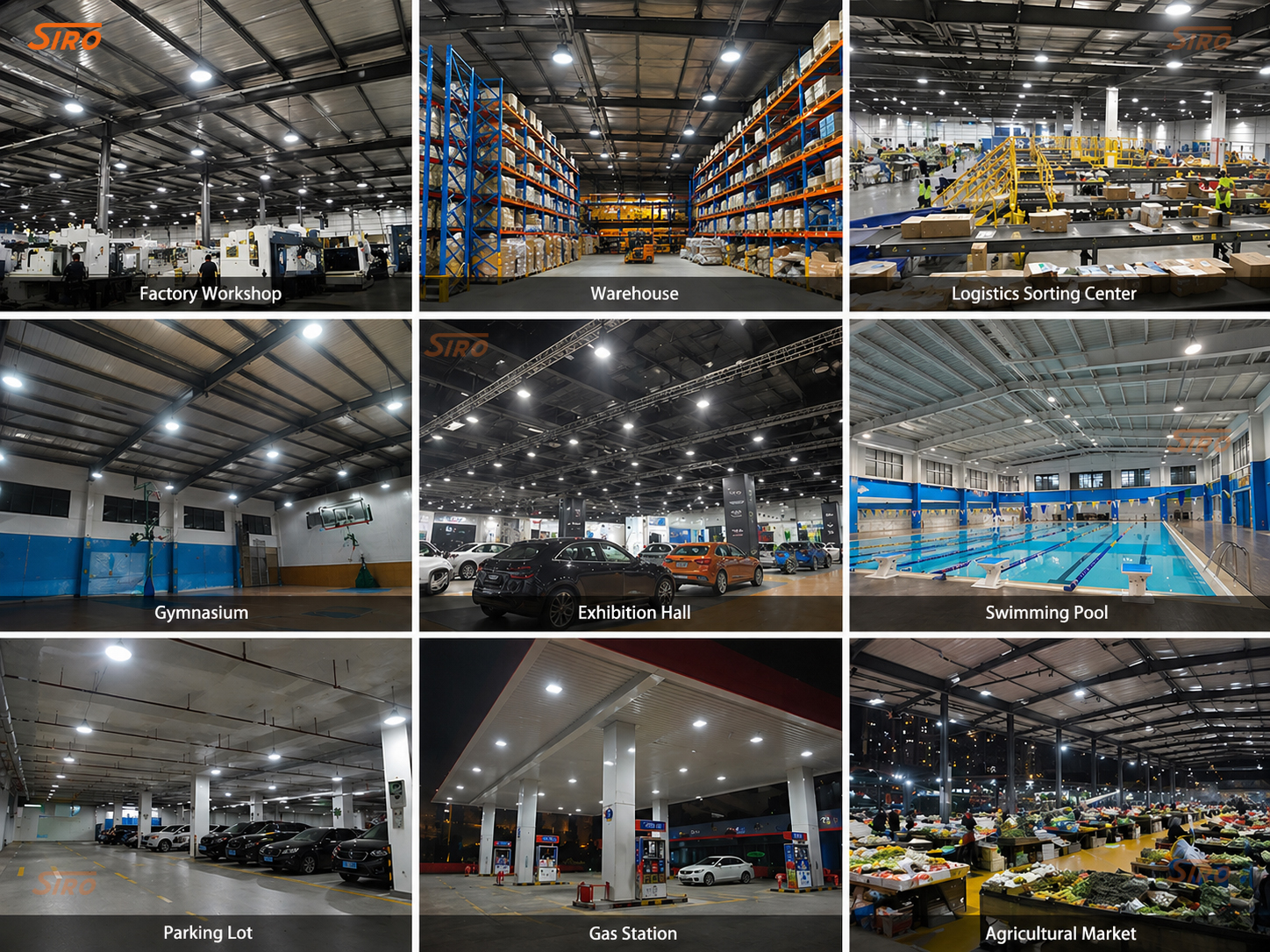
Warranty terms are often linked to the actual use environment. Customers should confirm whether the fixture is approved for the intended application, such as roads, warehouses, stadiums, gardens, or coastal areas. A 5-year warranty may require the product to be installed within a specified ambient temperature range and with proper voltage conditions.
For example, in outdoor projects with unstable power supply, the manufacturer may require a certain surge protection level. If the lighting is installed in high-humidity, high-salt, or high-temperature environments, the buyer should confirm in advance whether those conditions are covered.
3. Understand the Operating Limits
Another key point is the expected daily working time. Some warranties are based on standard operating conditions, such as 10 to 12 hours per day. If the fixture runs much longer, such as in industrial or security applications, the warranty conditions may differ.
Customers should also confirm whether lack of maintenance, improper wiring, or unsuitable installation will void the warranty. A reliable supplier should clearly explain the operating limits, installation method, and maintenance requirements.
4. Ask for Technical Evidence and Test Reports
A professional warranty should be supported by real product data, not only marketing language. Buyers should request key documents such as product specifications, IP66 test information, aging test records, and photometric or electrical reports where applicable.
For LED luminaires, stable heat dissipation and driver performance are essential for long-term reliability. A well-designed housing, quality driver, and proper thermal structure help reduce early failure. Therefore, customers should not only ask, “Do you offer 5 years?” but also, “What design and testing support that 5-year claim?”
5. Clarify the Warranty Claim Process
A practical warranty must include a clear service process. Customers should confirm how claims are handled, what evidence is required, and how quickly the supplier responds. Important questions include:
- Will the manufacturer provide replacement parts or complete fixtures?
- Is photo or video evidence required?
- Who covers shipping costs for replacements?
- What is the response time for technical support?
- Will spare parts be available for the full warranty period?
For project orders, especially overseas shipments, this point is critical. A good warranty should reduce after-sales risk, not create delays and uncertainty.
6. Verify Who Actually Stands Behind the Warranty
Finally, customers should confirm whether the warranty is provided by the factory, a trading company, or a brand owner. The supplier’s manufacturing capability, quality control system, and after-sales support directly affect how dependable the warranty will be.
A professional LED lighting manufacturer should be able to provide consistent production quality, aging tests, OEM/ODM support, and technical assistance after shipment. For long-term projects, this is often more important than the warranty statement alone.
Conclusion
A 5-year warranty on LED luminaires can be a strong sign of confidence, but buyers should always verify the details before ordering. The most important points are the warranty scope, application conditions, operating limits, technical documentation, claim procedure, and supplier responsibility.
At SIRO Light, we believe a reliable warranty must be backed by stable product quality, tested performance, and responsive after-sales support. If you are sourcing LED street lights, flood lights, high bay lights, or other outdoor lighting products, contact us to discuss the exact warranty terms for your project.