5 Common Mistakes in Solar Street Light Installation
How to Avoid Performance Failures in Solar Road Lighting Projects
As solar street lighting becomes increasingly popular for road projects, municipalities, contractors, and infrastructure developers are adopting Solar LED Street Lights to reduce electricity costs and simplify installation.
However, many solar street light projects fail to deliver the expected performance not because of product quality, but due to incorrect installation methods. Poor installation can significantly reduce battery life, lighting efficiency, and overall system reliability.
Understanding these common mistakes can help project owners, engineers, and distributors ensure stable long-term operation of solar road lighting systems.
At SIRO LIGHT, a professional Solar Street Light Manufacturer with over 16 years of outdoor lighting experience, we have supported many global road lighting projects. Based on real engineering feedback, here are the five most common mistakes in solar street light installation and how to avoid them.
1. Incorrect Solar Panel Orientation and Tilt Angle
One of the most frequent installation problems is improper solar panel orientation.
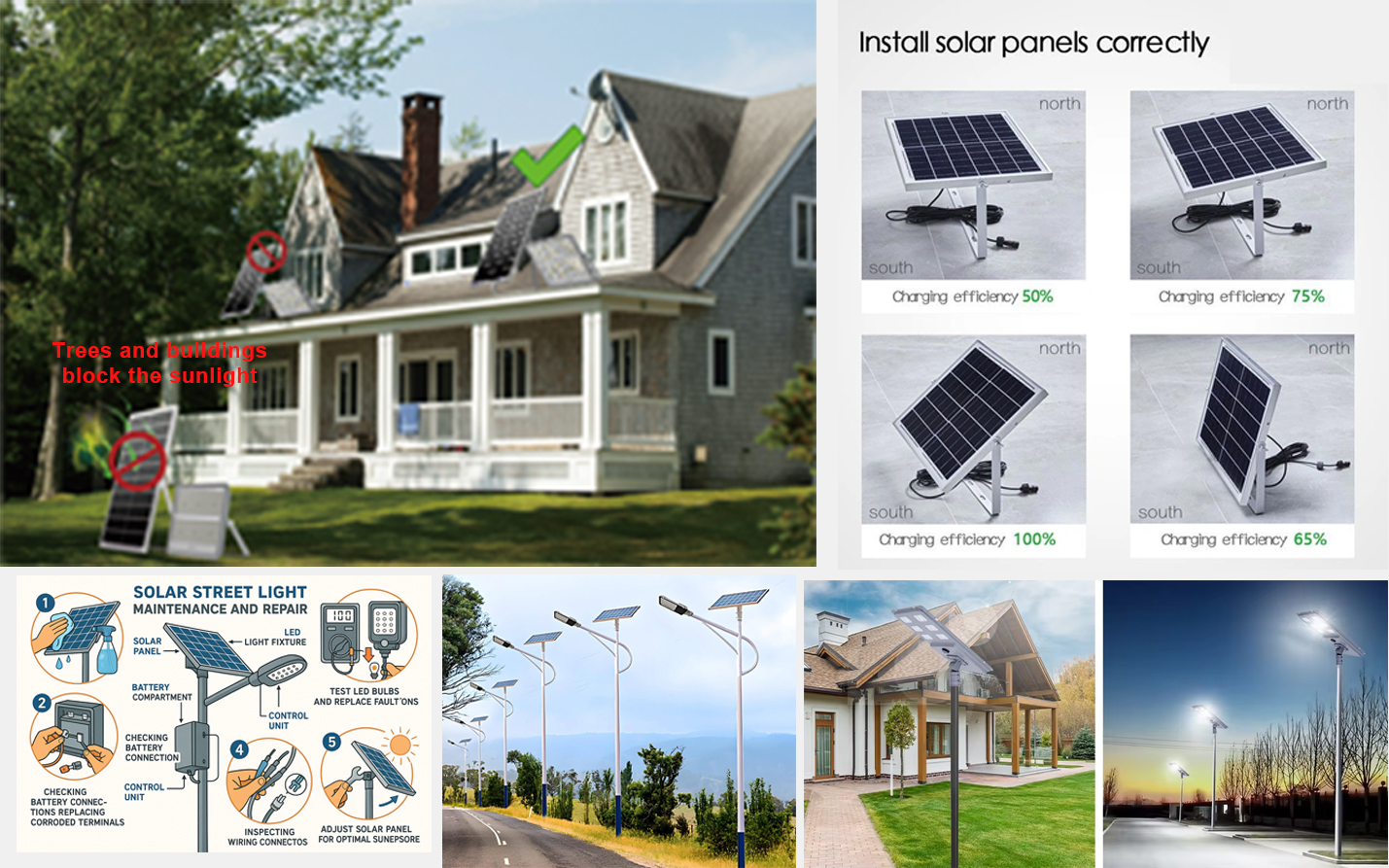
Solar panels must face the correct direction and be installed at the appropriate tilt angle to maximize sunlight absorption. If the panel angle is incorrect, the system will generate less electricity, causing insufficient battery charging.
Common problems include:
-
Solar panels installed flat instead of angled
-
Panels facing the wrong direction
-
Panels shaded by nearby buildings or trees
For most regions in the Northern Hemisphere, solar panels should face south with a tilt angle between 20° and 35°, depending on the latitude.
Proper orientation ensures the solar street light can generate enough energy during the day to support 10–12 hours of night lighting.
2. Installing Solar Lights in Shaded Areas
Another major issue is installing solar street lights in locations where sunlight exposure is blocked.
Solar lighting systems rely entirely on solar energy. If the solar panel is shaded for several hours per day, the battery will not charge sufficiently.
Typical shading sources include:
-
Tall buildings
-
Trees and branches
-
Billboards
-
Bridges or elevated roads
Even partial shading can reduce solar panel output by more than 40%.
Before installation, project planners should conduct a site sunlight assessment to ensure the solar panels receive at least 6–8 hours of direct sunlight daily.
This step is critical for high-efficiency solar road lighting performance.
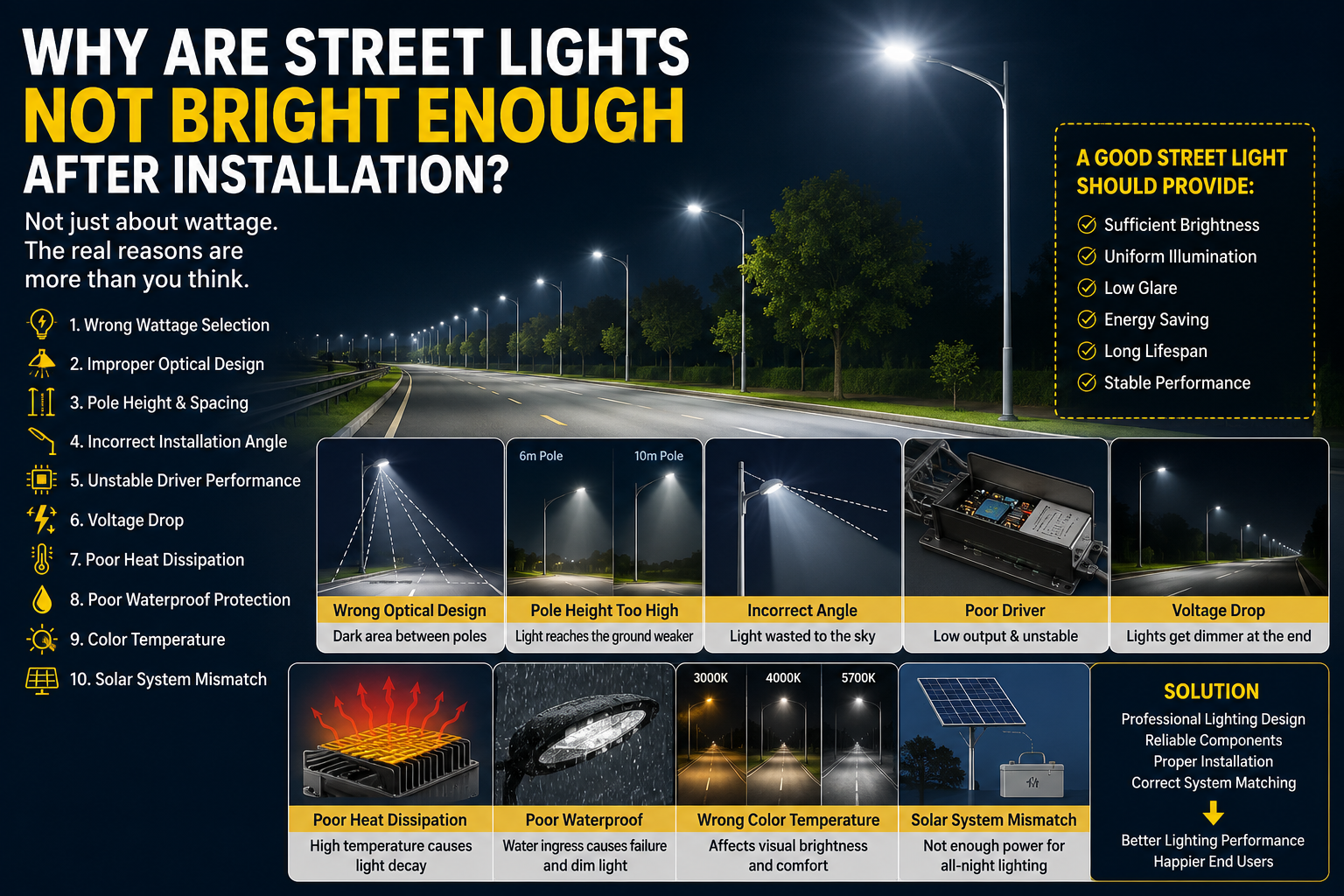
3. Improper Pole Height and Light Distribution
Many road lighting projects overlook the importance of correct pole height and spacing.
Solar street lights must be installed according to road width, lighting standards, and illumination requirements.
Common installation mistakes include:
-
Pole height too low, causing limited lighting coverage
-
Excessive spacing between poles
-
Incorrect beam angle selection
For example:
-
6–8 meter poles are suitable for small roads or rural streets
-
8–12 meter poles are recommended for highways and main roads
Proper lighting design ensures uniform light distribution, reduces dark spots, and improves road safety for pedestrians and vehicles.
Professional manufacturers usually provide IES photometric files to help engineers calculate lighting layouts.
4. Poor Waterproof Sealing and Cable Protection
Solar street lights are installed outdoors and exposed to harsh weather conditions, including rain, humidity, dust, and temperature changes.
If installation teams neglect waterproof protection, moisture can enter the lamp housing or electrical connections, causing system failures.
Common waterproof mistakes include:
-
Improper cable sealing
-
Loose connectors
-
Damaged waterproof gaskets
-
Poor installation of junction boxes
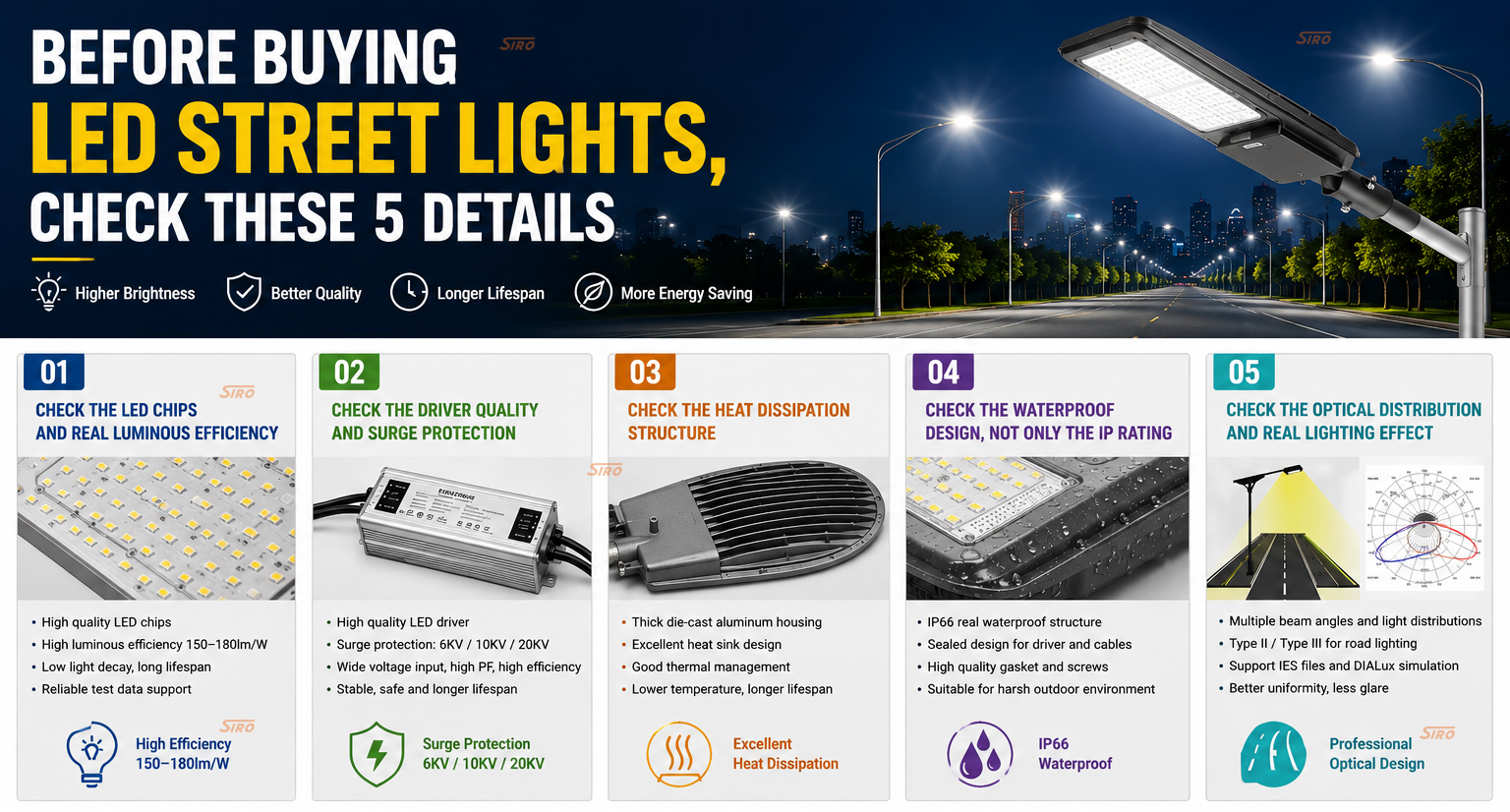
High-quality outdoor solar lights typically feature IP66 waterproof ratings, but correct installation is still essential to maintain system protection.
Using waterproof connectors and sealed cable entries helps prevent water intrusion and ensures long-term reliability.
5. Ignoring Battery Temperature and Heat Dissipation
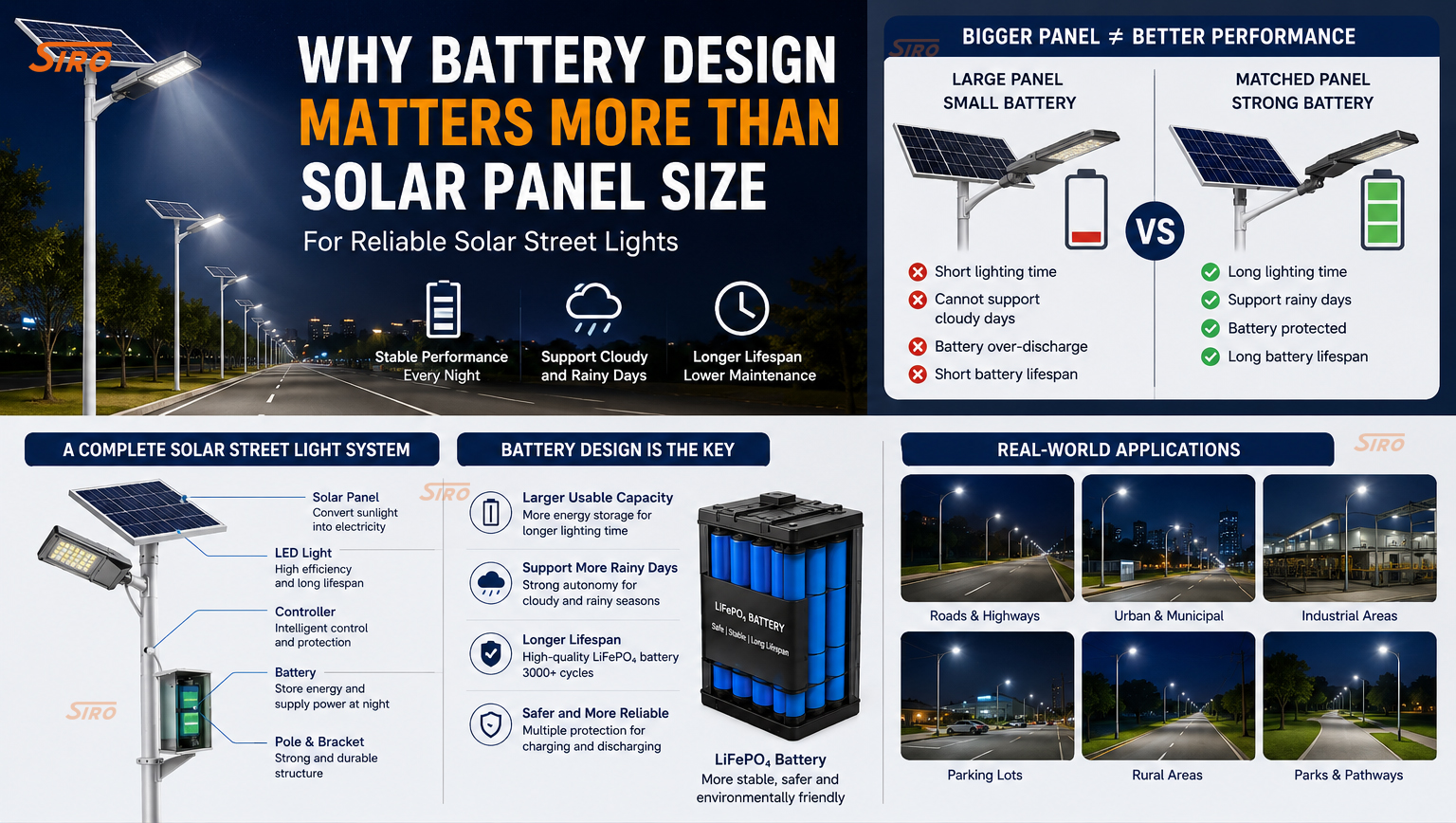
The battery is one of the most important components of a solar street lighting system.
Lithium batteries are sensitive to temperature. Excessive heat can reduce battery lifespan and decrease charging efficiency.
Installation mistakes related to battery management include:
-
Installing the battery in areas exposed to direct sunlight
-
Lack of ventilation inside the lamp housing
-
Poor thermal design
Advanced solar street lights use LiFePO4 lithium batteries, which offer better safety, longer life, and improved temperature resistance.
Proper thermal management ensures the battery can maintain stable performance for 5–8 years.
Choosing the Right Solar Street Light Manufacturer
In addition to correct installation, choosing a reliable supplier is essential for project success.
A professional manufacturer should provide:
-
Accurate solar lighting calculations
-
IES photometric lighting design
-
High-efficiency LED chips
-
Durable die-cast aluminum housing
-
IP66 waterproof protection
-
Long-life lithium battery systems
Zhongshan Siro Light Co., Ltd. (SIRO LIGHT) specializes in manufacturing high-performance solar street lights, LED street lights, flood lights, and outdoor lighting solutions.
With more than 16 years of OEM and ODM experience, we provide customized lighting solutions for road projects, municipalities, contractors, and global distributors.
Our solar street lights are widely used in:
-
Highway lighting
-
Rural road lighting
-
Residential communities
-
Industrial parks
-
Government infrastructure projects
Conclusion
Solar street lights are an excellent solution for energy-efficient outdoor lighting, but proper installation is critical to achieving optimal performance.
Avoiding these five common mistakes can significantly improve system reliability and lighting efficiency:
-
Incorrect solar panel orientation
-
Installing lights in shaded areas
-
Improper pole height and spacing
-
Poor waterproof sealing
-
Ignoring battery temperature management
By combining professional installation practices with high-quality solar lighting products, project owners can ensure long-lasting and reliable solar road lighting systems.
If you are planning a solar street light project or looking for a trusted Solar Street Light Manufacturer, SIRO LIGHT can provide professional support and reliable solutions.
Keywords
Solar Street Light, Solar LED Street Light, Solar Road Lighting, Outdoor Solar Lighting, Solar Street Light Installation, Solar Lighting Manufacturer, Solar Street Light Project, LED Solar Street Lamp, Solar Powered Street Light, SIRO LIGHT