Why Battery Design Matters More Than Solar Panel Size in Solar Street Lights
When buyers choose solar street lights, many people first look at the solar panel size.
“Is the panel big enough?”
“How many watts is the solar panel?”
“Will a bigger panel make the light work better?”
These are common questions, and solar panel size is important. But in real outdoor lighting projects, especially for roads, villages, parking lots, industrial areas, municipal lighting, and remote infrastructure, the most important factor is often not the panel size alone.
The real question is:
Can the solar street light store enough energy and deliver stable lighting every night?
That depends mainly on the battery design.
A solar panel collects energy during the day, but the battery decides whether the light can work properly at night, during cloudy days, and after long-term outdoor use.
For professional buyers, distributors, contractors, and project owners, battery design is one of the most critical parts of a reliable solar street lighting system.
1. A Solar Panel Generates Power, but the Battery Keeps the Light Working
A solar street light is not just a lamp with a solar panel. It is a complete energy system.
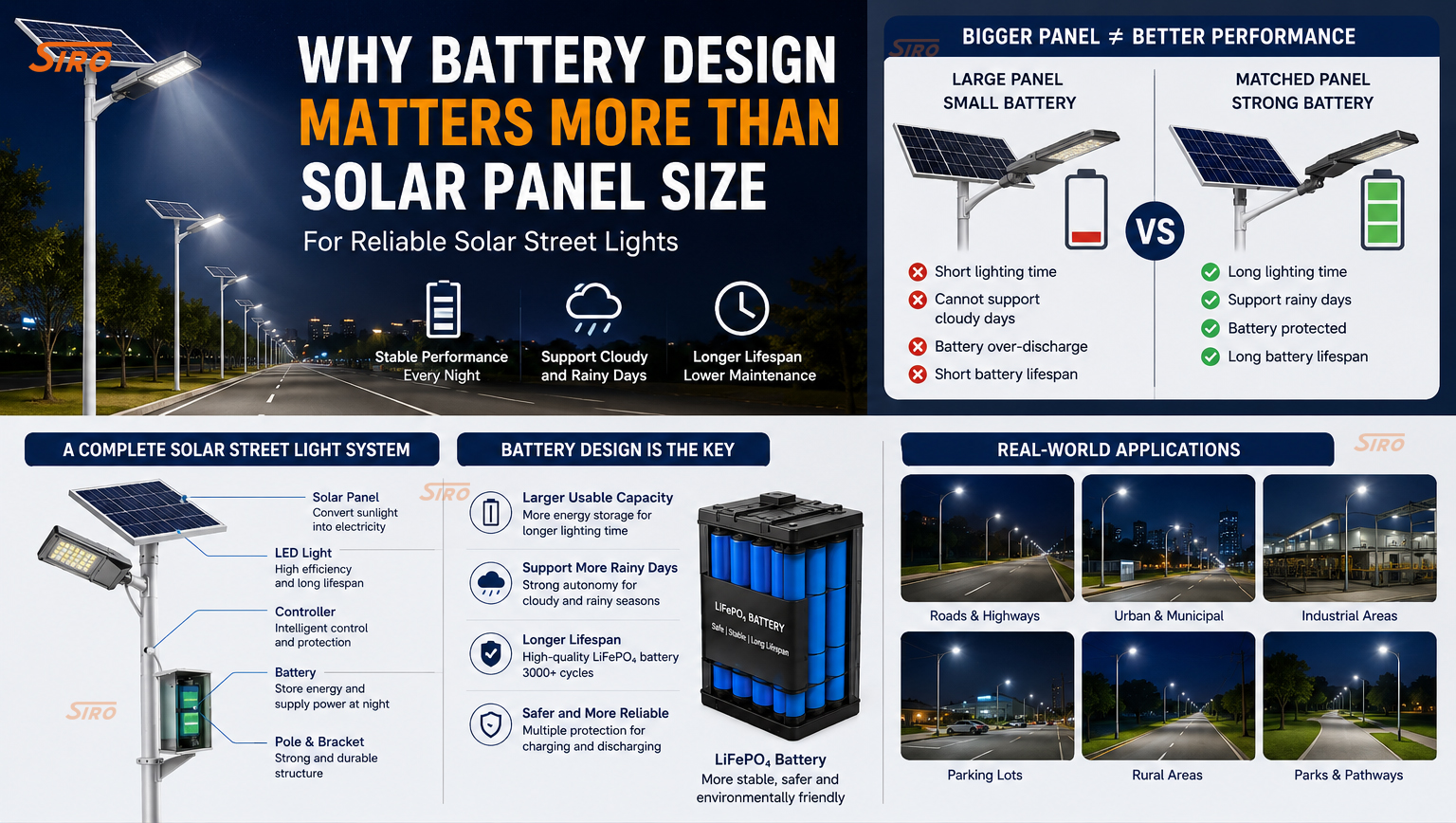
A complete solar street light system includes:
✅ Solar panel
✅ Battery
✅ LED light source
✅ Controller
✅ Housing structure
✅ Mounting bracket
✅ Cable and waterproof connection
✅ Lighting control program
The solar panel generates electricity during the day, but this power must be stored in the battery first. At night, the LED lamp does not receive power directly from sunlight. It receives power from the battery.
That means the battery is responsible for the real working performance of the system after sunset.
A large solar panel may charge faster during the day, but if the battery capacity is too small, the system still cannot support long lighting hours at night.
From a buyer’s point of view, the most important concern is not whether the product looks big. The real concern is whether the light can stay on reliably, night after night.
2. Customers Care About Lighting Time, Not Just Product Appearance
In many markets, solar street lights are installed in outdoor environments where maintenance is difficult and expensive.
Customers usually care about these practical questions:
✅ Can the light work for 10–12 hours every night?
✅ Can it support cloudy or rainy days?
✅ Will the battery lose capacity quickly?
✅ Will the light become dim after several months?
✅ Will there be many after-sales problems?
✅ Is the system suitable for local climate conditions?
These questions are directly connected to battery design.
A solar street light may look strong from the outside. It may have a large panel, a modern housing, and a high lumen claim. But if the battery capacity is not properly designed, the product may still fail in real projects.
For example, the light may work well in the first few days after installation. But after several cloudy days, long rainy seasons, high temperatures, or repeated deep discharge, the system may begin to show problems.
Common problems include:
- Shorter lighting time
- Weak brightness after midnight
- Early battery failure
- Controller protection shutdown
- Unstable charging and discharging
- Inconsistent performance between batches
- High maintenance cost
This is why professional solar street light buyers should pay more attention to battery design than appearance or panel size alone.
3. A Bigger Solar Panel Does Not Always Mean a Better System
Many customers believe that a larger solar panel automatically means better performance. But this is not always true.
A solar street light system must be balanced.
If the solar panel is large but the battery capacity is small, the system cannot store enough energy. It is like having a large water pipe connected to a small water tank. Even if the water flow is strong, the storage capacity is still limited.
If the battery cannot store enough energy, the light will still have limited working time at night.
A larger solar panel also cannot solve all project problems.
Real charging performance can be affected by:
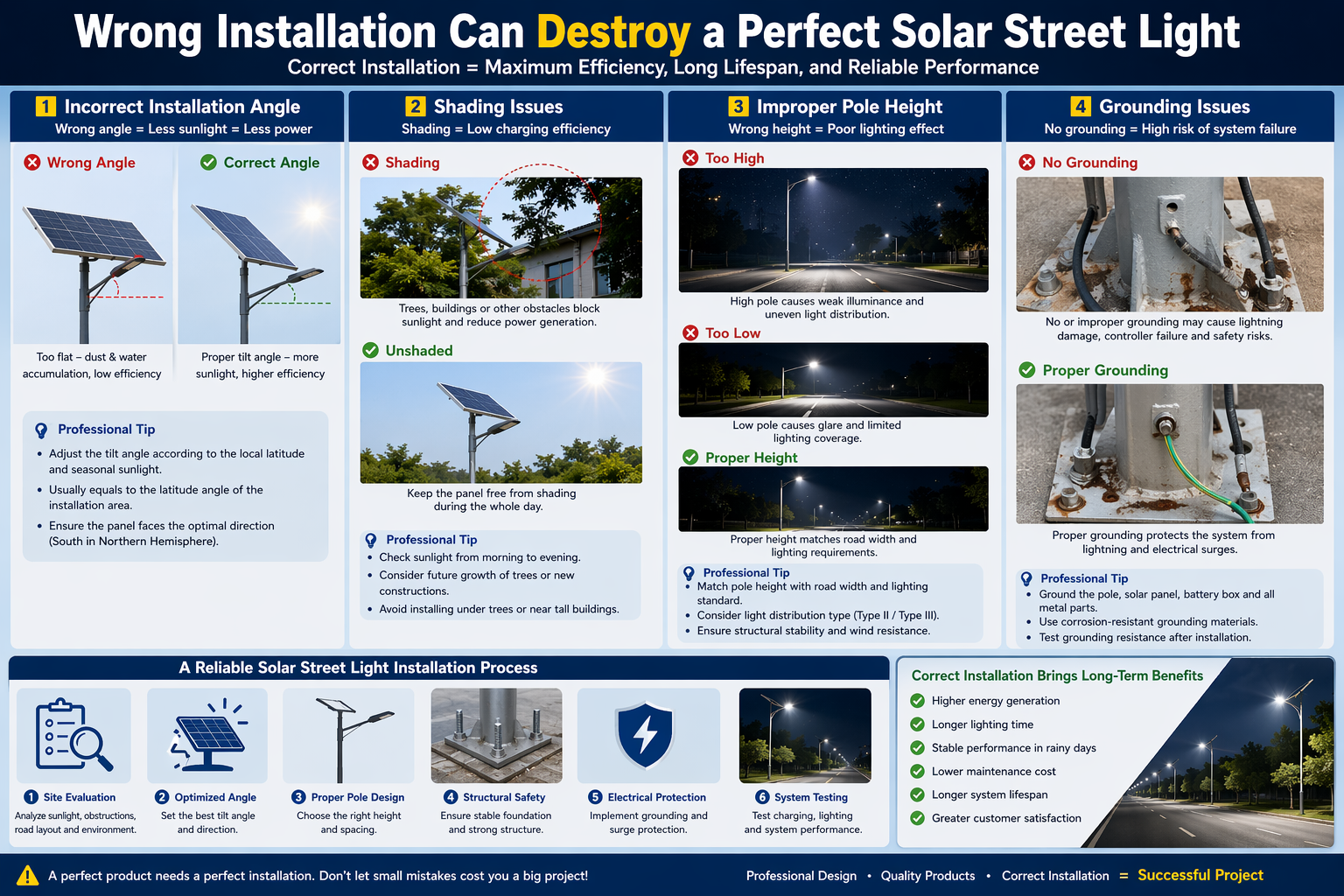
- Installation angle
- Local sunlight hours
- Dust on the panel surface
- Shading from trees or buildings
- Rainy season
- Controller efficiency
- Cable loss
- Battery storage capacity
So, the best solar street light system is not simply the one with the biggest panel. It is the one with the correct balance between solar panel, battery, controller, LED power, lighting mode, and local climate conditions.
4. Battery Capacity Determines Real Autonomy Days
One of the most important questions in solar street lighting projects is:
How many cloudy or rainy days can the system support?
This is called autonomy.
Autonomy depends mainly on battery capacity and system power consumption.
If the battery capacity is too small, the light may work normally on the first night, become weaker on the second night, and stop working on the third night.
For projects in areas with unstable sunlight, rainy seasons, or long winter nights, battery capacity becomes even more important.
Different markets have different requirements:
- In the Middle East, high temperature can accelerate battery aging.
- In Southeast Asia, long rainy seasons require stronger energy storage.
- In Africa, remote roads often need low-maintenance systems.
- In South America, distributed infrastructure projects need reliable long-term performance.
- In island or coastal regions, humidity and corrosion may affect battery compartments and cable sealing.
This is why battery design must be based on real project conditions, not only on a standard product specification.
A professional solar street light supplier should calculate the battery capacity according to:
✅ Lamp power
✅ Working hours per night
✅ Dimming mode
✅ Local sunlight conditions
✅ Required rainy days
✅ Battery discharge depth
✅ Controller efficiency
✅ Project maintenance difficulty
Without proper battery design, even a large solar panel cannot guarantee stable night lighting.
5. Battery Quality Affects the Whole Lifetime of the Solar Street Light
The battery is one of the most hardworking components in a solar street light system.
Every day, it goes through charging and discharging cycles.
During the day, it stores energy from the solar panel.
At night, it releases energy to power the LED light.
During rainy days, it may work under low charging conditions.
In hot climates, it may face high temperature stress.
In long-term use, it must maintain stable capacity over many cycles.
If the battery quality is poor, the problem may not appear immediately. But after several months or one year, the capacity may drop quickly.
For customers, this creates serious after-sales pressure.
If one solar street light fails, the maintenance cost may be acceptable. But if a project has hundreds or thousands of lights, battery problems can become a major project risk.
Battery failure may lead to:
- Frequent customer complaints
- High replacement cost
- Labor cost for maintenance
- Equipment cost for high-pole repair
- Project reputation damage
- Loss of repeat orders
- Lower trust from local buyers
For distributors and contractors, product stability is directly connected to business reputation. A weak battery system can damage not only one project, but also long-term customer relationships.
That is why battery design must be treated as a core part of the solar street lighting system.
6. The Controller Must Match the Battery System
Battery performance is not only about capacity. It is also about how the battery is managed.
The controller plays a key role in protecting the battery and improving system efficiency.
A good controller should support:
✅ Overcharge protection
✅ Over-discharge protection
✅ Short-circuit protection
✅ Temperature protection
✅ Intelligent dimming
✅ Time-based lighting control
✅ MPPT or high-efficiency charging management
✅ Battery status monitoring
If the controller is not properly matched, even a good battery can be damaged faster.
For example, if the battery is often deeply discharged during rainy days, its life will be shortened. If the system has no proper low-voltage protection, the battery may be pushed beyond a safe working range.
A smart controller can adjust the lighting mode according to battery status. It can reduce power consumption when energy is limited and help the system work longer during cloudy or rainy days.
This is why professional solar street light design should not only focus on bigger panels or higher lumen data. It should focus on complete system logic.
The solar panel, battery, controller, LED module, and working mode must be designed together.
7. Battery Design Directly Affects Maintenance Cost
For customers, the real cost of a solar street light is not only the purchase price.
The real cost includes:
- Installation cost
- Maintenance cost
- Replacement cost
- Labor cost
- Transportation cost
- Project downtime
- After-sales service cost
- Brand reputation risk
If the battery design is reliable, the system can work more steadily and reduce maintenance frequency.
If the battery design is weak, the customer may need to replace batteries frequently. This is especially difficult for high-pole street lights, remote roads, large outdoor areas, and overseas projects.
In many road lighting projects, replacing a battery is not a simple job. It may require workers, lifting equipment, transportation, tools, and safety arrangements.
That means a low-cost battery design can become very expensive after installation.
For serious buyers, it is better to choose a properly designed system from the beginning than to spend more money solving problems later.
8. Real Capacity Is More Important Than Beautiful Specifications
In the solar street light market, one of the biggest concerns for buyers is inaccurate product specifications.
Some products look impressive on paper. The panel looks large. The housing looks strong. The battery capacity looks high. The lumen data looks attractive.
But real performance may be very different.
Professional buyers should not only look at the written capacity. They should ask about real usable capacity.
Important questions include:
✅ What is the real battery voltage?
✅ What is the real amp-hour capacity?
✅ What is the total watt-hour capacity?
✅ What type of battery cell is used?
✅ Is it LiFePO4 battery or another type?
✅ What is the discharge depth setting?
✅ What is the charging efficiency?
✅ Can the supplier provide production or testing details?
✅ Can the system be customized for the project location?
For solar street lights, Wh capacity is often more meaningful than just Ah capacity, because voltage and system design also matter.
A professional supplier should be able to explain the relationship between battery capacity, lamp power, working hours, dimming program, and autonomy days.
If a supplier only says “big panel” or “high brightness” but cannot explain battery calculation, the project may carry hidden risks.
9. Why Professional Buyers Pay More Attention to Battery Design
Professional buyers usually think beyond the first purchase.
They care about long-term project performance.
A distributor wants products that are easy to sell and hard to complain about.
A contractor wants products that reduce maintenance work after installation.
A municipal project owner wants lights that can remain stable for years.
An importer wants consistent quality from batch to batch.
A brand owner wants products that protect market reputation.
For these customers, battery design is not a small detail. It is a major purchasing decision.
A reliable battery system helps improve:
- Lighting stability
- Customer satisfaction
- Project reputation
- Long-term product value
- Repeat order potential
- Local market competitiveness
This is why serious buyers should not only compare price, panel size, or product appearance. They should compare the complete energy system design.
10. How SIRO Light Understands Solar Street Light Battery Design
Zhongshan Siro Light Co., Ltd. is a professional LED outdoor lighting manufacturer located in Guzhen, Zhongshan, China, known as the Global Lighting Capital.
SIRO Light focuses on high-performance outdoor lighting products, including LED street lights, solar street lights, LED flood lights, LED high bay lights, garden lights, and outdoor lighting solutions for global markets.
For solar street light projects, SIRO Light pays close attention to complete system matching instead of only promoting large panel size.
Our solar street light design focuses on:
✅ Proper solar panel and battery matching
✅ Practical battery capacity calculation
✅ Stable LiFePO4 battery solutions
✅ Intelligent controller protection
✅ Working mode design for real night lighting
✅ Rainy-day autonomy planning
✅ Outdoor waterproof structure
✅ Project-based configuration support
✅ OEM/ODM customization for distributors and contractors
We understand that buyers are not only purchasing a solar light. They are investing in a long-term outdoor lighting system.
That is why a reliable solar street light should be designed according to real project needs, including road width, pole height, installation environment, local sunlight, working hours, brightness requirements, and maintenance conditions.
11. What Buyers Should Ask Before Choosing Solar Street Lights
Before choosing a solar street light supplier, buyers should ask more professional questions.
Instead of only asking “How big is the solar panel?”, it is better to ask:
- What is the real battery capacity?
- What battery type is used?
- Is it LiFePO4 battery?
- How many hours can the light work every night?
- How many rainy days can the system support?
- What is the dimming program?
- What controller is used?
- Does the controller protect against overcharge and over-discharge?
- Is the battery capacity matched with the LED power?
- Can the system be adjusted for my country or project location?
- Can the supplier provide project experience or technical support?
- Can the factory support stable batch production?
These questions help buyers identify whether the supplier truly understands solar street lighting systems.
A professional supplier should not only provide a product price. It should provide a complete solution.
12. Conclusion: The Best Solar Street Light Is a Balanced Energy System
Solar panel size is important, but it is not the only factor that decides solar street light performance.
In real outdoor lighting projects, battery design is often more important because it directly affects:
✅ Night lighting time
✅ Rainy-day performance
✅ System stability
✅ Battery lifetime
✅ Maintenance cost
✅ Customer satisfaction
✅ Project reputation
✅ Long-term return on investment
A reliable solar street light should not only look strong. It should be able to work stably in real outdoor conditions.
For professional buyers, the best choice is not always the product with the biggest panel. The best choice is the system with the right balance between solar panel, battery, controller, LED power, structure, and project environment.
At SIRO Light, we believe solar street lights should be designed as complete outdoor energy systems, not just lamps with solar panels.
Zhongshan Siro Light Co., Ltd. provides professional LED outdoor lighting and solar street lighting solutions for distributors, importers, contractors, municipal projects, and road lighting customers worldwide.
If your project requires stable lighting performance, practical battery design, reliable outdoor structure, and long-term support, SIRO Light can help you build a more dependable solar street lighting solution.
SEO Keywords
solar street light, solar street light battery design, LED solar street light, outdoor solar lighting, solar street light factory, solar street light manufacturer in China, lithium battery solar street light, LiFePO4 solar street light, solar street light system, road lighting solution, SIRO Light, Zhongshan Siro Light Co., Ltd., LED outdoor lighting manufacturer, solar powered street light, commercial solar street light, municipal solar street lighting, solar street light battery capacity, solar panel and battery matching, outdoor LED lighting solution