What Problems Can IES Photometric Testing Solve for Road Lighting Projects?
In road lighting projects, customers are not only buying luminaires. They are buying lighting performance, road safety, project compliance, and long-term operating efficiency. This is exactly why IES photometric testing is so important.
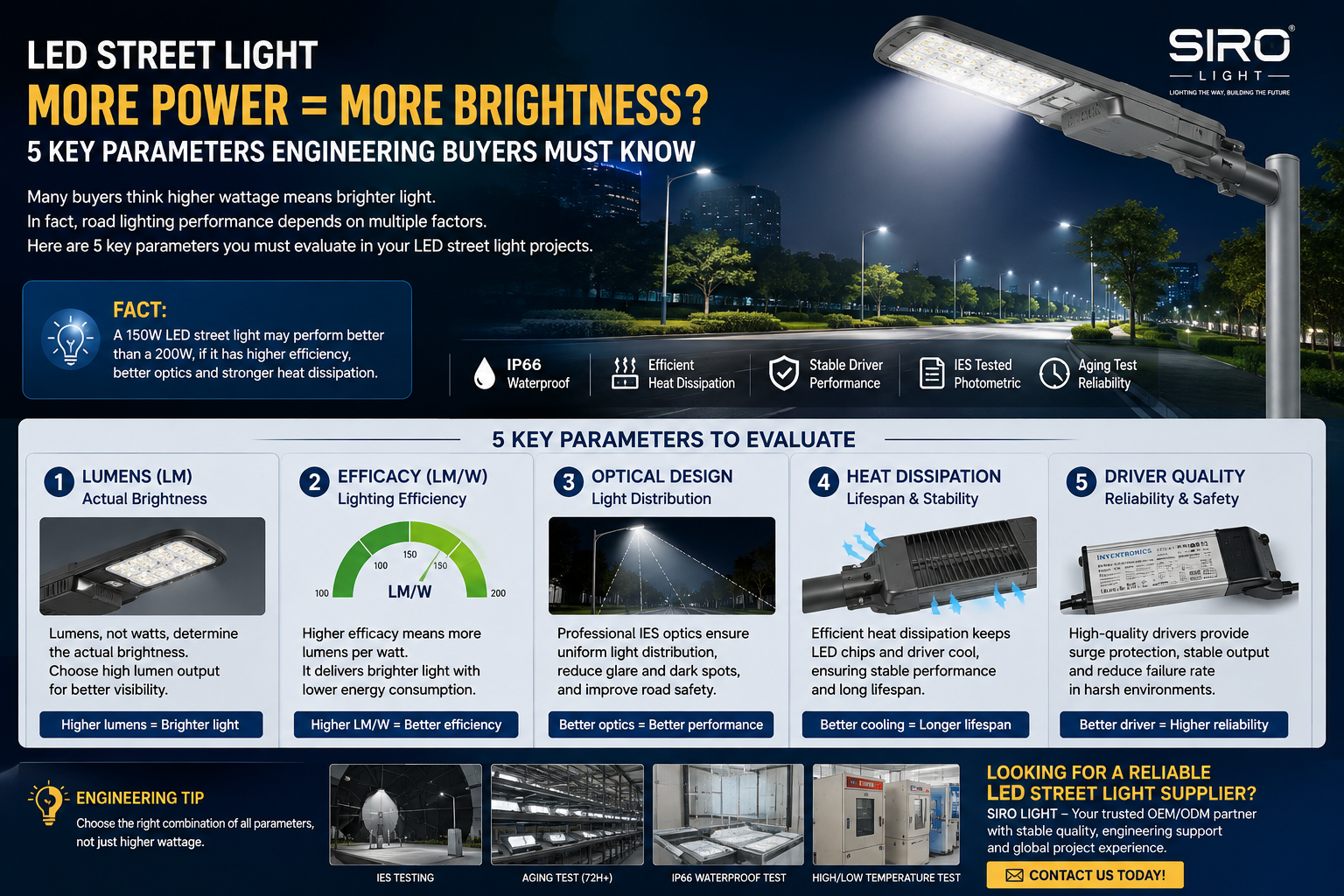
Many buyers focus first on wattage, lumen output, or price. But in real projects, these figures alone cannot tell whether a street light will actually perform well on the road. A fixture may look powerful on paper, but if the light distribution is wrong, the result can be poor uniformity, glare, dark zones, wasted energy, and even project rejection.
So, what does IES photometric testing really solve?
✓ 1. It shows how the light is distributed
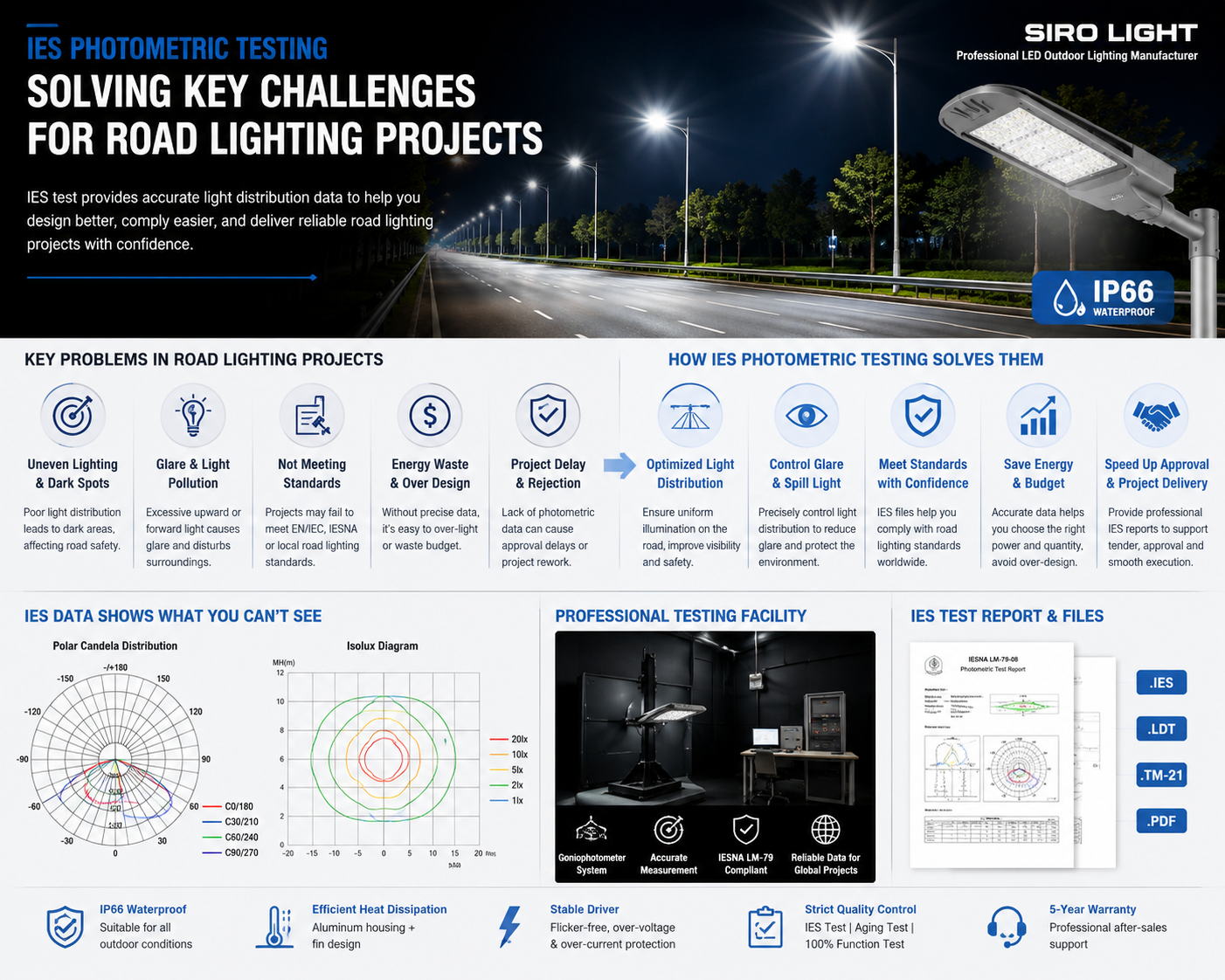
IES data records the real photometric performance of the fixture, including beam pattern, light intensity, and distribution angles.
For road projects, this helps answer critical questions such as:
• Will the light reach both sides of the road properly?
• Is the beam suitable for narrow roads, highways, intersections, or parking areas?
• Will there be dark spots between poles?
• Is the light concentrated where it is needed, or wasted outside the target area?
Without accurate photometric data, choosing a fixture is often based on guesswork.
✓ 2. It helps improve road uniformity and safety
For road lighting, brightness alone is never enough. What matters more is uniform illumination.
Poor uniformity can create alternating bright and dark areas, making it harder for drivers, cyclists, and pedestrians to see clearly. This affects visual comfort and road safety. With IES testing, lighting designers can simulate the actual road effect before installation and verify whether the fixture delivers proper average illumination and uniformity.
This is especially important for:
• Urban roads
• Highways
• Residential streets
• Industrial parks
• Port roads and logistics areas
✓ 3. It helps control glare
Excessive glare is a common problem in street lighting projects. A light may be bright, but if glare is too strong, it can reduce visibility rather than improve it.
IES files help engineers evaluate the optical distribution and choose the right lens design, mounting angle, and installation method. This helps reduce discomfort glare and improve visual clarity for drivers and pedestrians.
✓ 4. It supports correct pole spacing, mounting height, and wattage selection
One of the biggest customer concerns is: How many lights do I need, and what wattage should I choose?
IES-based lighting simulation helps answer this clearly by calculating:
• Pole spacing
• Mounting height
• Arm length
• Road width coverage
• Required lux level
• Best wattage and optics combination
This avoids two costly mistakes:
under-lighting, which creates safety risks, and over-lighting, which increases project cost and energy consumption.
✓ 5. It reduces project risk before installation
For contractors, consultants, and project buyers, wrong product selection can lead to rework, delayed approval, and customer complaints.
With IES photometric testing, the lighting effect can be evaluated before mass production or shipment. This reduces uncertainty and helps all parties make decisions with more confidence. In many cases, it also supports tender documents, technical submittals, and project approval processes.
✓ 6. It helps save energy and optimize long-term cost
A well-designed road lighting system is not simply the brightest one. It is the one that achieves the required lighting standard with the most efficient optical design.
IES testing helps optimize fixture quantity and power selection, which can reduce:
• Energy waste
• Excessive fixture count
• Installation cost
• Long-term maintenance burden
For municipalities, developers, and infrastructure contractors, this directly affects ROI.
Why customers should care
From a customer’s perspective, IES photometric testing is not just a technical report. It is a practical tool that helps ensure:
✓ better road safety
✓ more accurate lighting design
✓ easier project approval
✓ lower installation risk
✓ improved energy efficiency
✓ more professional project delivery
Final thought
In road lighting projects, the real question is not “How many watts is this street light?” but rather, “How well will this light perform on the road?”
That is the value of IES photometric testing. It turns product data into visible project results and helps customers choose lighting solutions with greater confidence, accuracy, and long-term reliability.