10 Questions You Must Confirm Before Buying LED Lighting for Overseas Projects
When purchasing LED lighting for overseas engineering projects, price should never be the only factor. Whether you are sourcing LED street lights, solar street lights, flood lights, high bay lights, or garden lights, one wrong decision can lead to installation delays, poor lighting performance, warranty disputes, and extra maintenance costs.
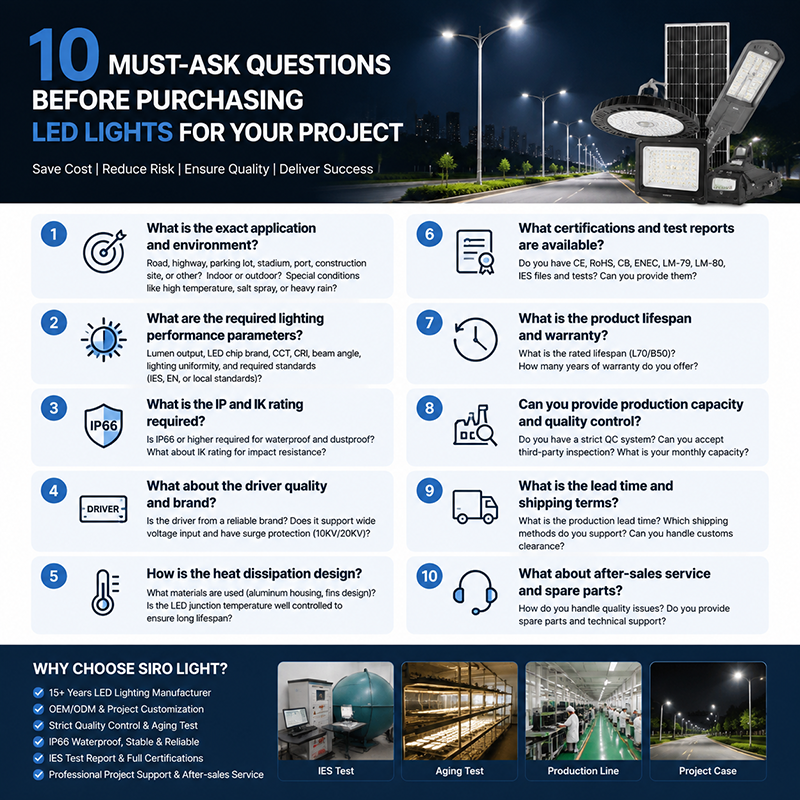
For contractors, distributors, and project buyers, the smarter approach is to ask the right questions before placing an order. Here are the 10 most important questions you should confirm before buying LED lighting for international projects.
1. What is the exact application and project requirement?
Start with the real use scenario. Is the fixture for roads, warehouses, stadiums, parking lots, gardens, or construction sites? Different applications require different lumen output, beam angles, mounting methods, and protection levels. A street light for municipal roads is very different from a high bay light for industrial workshops. Clear project requirements help avoid choosing the wrong product from the beginning.
2. What lighting standard must the product meet?
Many buyers focus on wattage, but professional projects focus on lighting results. Ask whether the product can meet the required road lighting class, lux level, uniformity, glare control, or height requirement. For outdoor and roadway projects, lighting simulation and IES files are especially important. A reliable supplier should be able to support lighting design, not just send a quotation.
3. How efficient is the fixture in real performance?
Do not only ask for “high brightness.” Ask for the actual lumen output, luminous efficacy, color temperature, CRI, and beam angle. In project procurement, real performance data matters more than marketing words. A good LED fixture should balance energy saving and stable light output. If possible, request LM79 or equivalent test data to verify actual performance.
4. Is the heat dissipation structure reliable?
Heat is one of the biggest reasons LED fixtures fail early. Ask about the housing material, fin structure, thermal design, and operating temperature range. A well-designed die-cast aluminum housing with effective heat dissipation can greatly improve product lifespan. This is especially critical for high-power products such as LED flood lights, stadium lights, and high bay lights.
5. Is the driver stable and suitable for the target market?
The driver is the core of the fixture. Confirm the driver brand, input voltage range, surge protection level, power factor, and dimming compatibility. Overseas projects may require 100–277V or 220–240V input, depending on the market. For unstable grid environments, surge protection is particularly important. A stable driver means fewer failures, lower maintenance costs, and better project reliability.
6. Does the product have the right protection level?
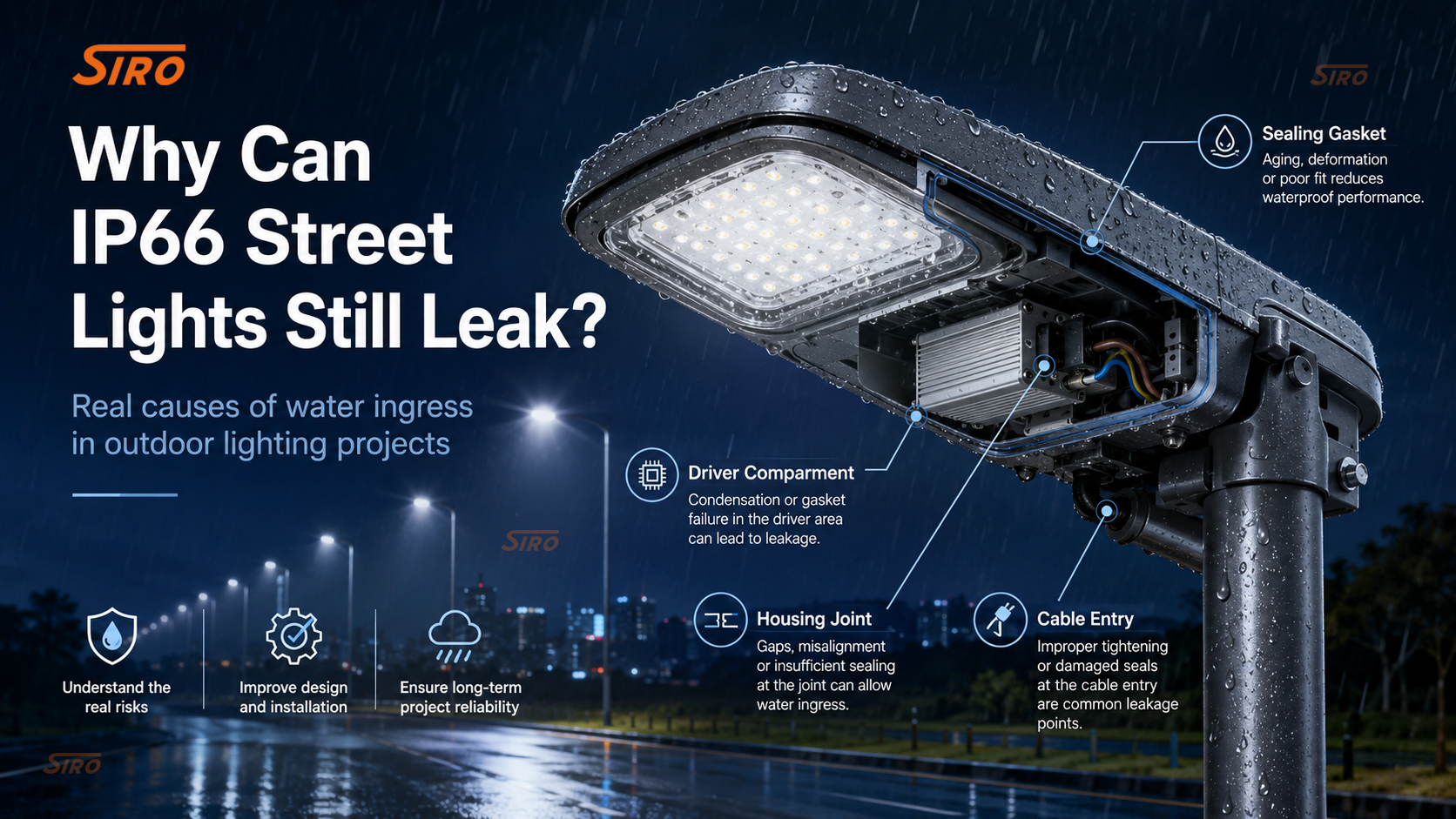
For outdoor projects, always confirm IP rating, IK rating, and corrosion resistance. For example, IP66 is a common requirement for street lights and flood lights exposed to rain, dust, and harsh weather. In coastal or humid environments, anti-corrosion treatment is also important. If the product is installed in rough industrial conditions, stronger impact resistance should also be considered.
7. Are complete test reports and certifications available?
Professional buyers should always ask for documentation. Important files may include IES files, LM79 reports, aging test reports, surge test results, waterproof test records, and material specifications. Certifications such as CE, RoHS, CB, UL, SAA, or other local compliance documents may also be required depending on the destination country. A serious factory should be able to provide these clearly and quickly.
8. Can the supplier support customization and project matching?
Not every project is standard. You may need different wattages, photocells, smart control systems, special brackets, logo printing, packaging, or solar solutions. Ask whether the factory supports OEM/ODM service and whether they have real project experience. A manufacturer with customization ability can help you solve project problems more efficiently than a trader offering only fixed models.
9. What quality control process does the factory follow?
Before ordering, understand how the supplier controls quality. Ask whether they conduct incoming material inspection, production inspection, 100% aging test, waterproof testing, and final inspection before shipment. Stable quality is not just about samples looking good; it depends on whether the manufacturer has a consistent process. For engineering buyers, this is one of the most important risk-control points.
10. What warranty and after-sales support are included?
A long warranty sounds good, but the real question is: how will the supplier handle problems if they occur? Ask about warranty years, replacement policy, spare parts support, response time, and technical assistance. For overseas buyers, responsive after-sales communication is extremely valuable. A dependable supplier should support installation questions, troubleshooting, and future reorder consistency.
Final Thoughts
Successful LED project procurement is not only about finding a lower price. It is about choosing the right product, the right technical solution, and the right manufacturing partner. By confirming these 10 questions in advance, you can reduce project risk, improve lighting performance, and avoid unnecessary cost later.
If you are sourcing LED street lights, solar street lights, LED flood lights, high bay lights, or other project lighting products, work with a factory that understands engineering requirements, offers OEM/ODM flexibility, and provides stable quality with full testing support.
Suggested article image prompt:
A professional overseas LED lighting procurement scene: an engineer and purchasing manager reviewing LED street light, flood light, and high bay light specifications on a table in a modern factory meeting room; product samples visible; technical drawings, IES test report sheets, and laptop with lighting simulation on screen; industrial, clean, realistic style; bright natural lighting; blue and gray color tone; emphasizes quality control, engineering decision-making, and international project procurement.