From Installation to Illumination: Real Solar Street Lighting Project in Middle East Desert Conditions
How Reliable Solar Street Lights Are Engineered for Harsh Environments
In many Middle Eastern countries, public lighting is not just about brightness—it is about reliability under extreme conditions. High temperatures, dust storms, unstable grid power, and long operational hours demand more than standard lighting products.
This real project showcases a complete process—from daytime installation to nighttime performance—demonstrating how a properly engineered solar street lighting system can deliver stable, long-term operation in demanding environments.
Project Overview: Solar Street Lighting in a Desert Urban Area
The installation was carried out in a typical Middle Eastern city environment, where:
- High ambient temperatures exceed 50°C in summer
- Dust and sand exposure are constant
- Infrastructure expansion requires fast deployment and low maintenance solutions
- Grid instability increases the demand for off-grid lighting systems
To meet these challenges, an integrated solar street lighting system was selected to ensure independent operation, energy efficiency, and long-term durability.
Daytime Installation: Engineering Matters More Than Product
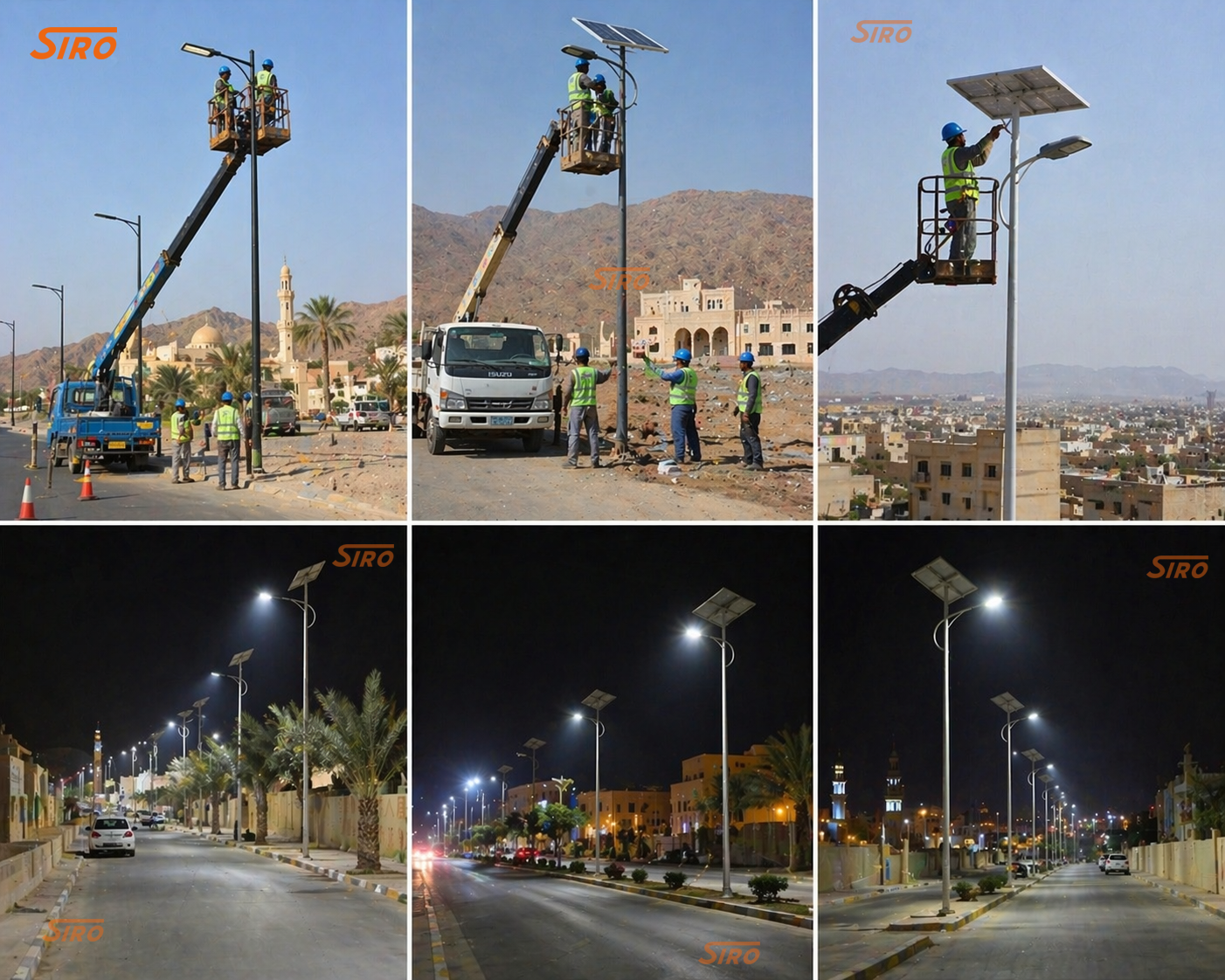
From the installation images, it is clear that the project follows a standardized engineering process, which is critical for long-term performance.
1. Professional Equipment & Safety Standards
Installation is carried out using aerial lift platforms, ensuring:
- Accurate positioning of luminaires
- Safe working conditions for technicians
- Proper alignment of poles and fixtures
Workers are equipped with safety helmets and reflective clothing, meeting international project standards.
2. Solar Panel Orientation & Tilt Angle Optimization
One of the most overlooked factors in solar lighting projects is panel positioning.
In this project:
- Panels are installed at optimized tilt angles to maximize solar energy absorption
- Orientation avoids shading from buildings and trees
- Structural brackets ensure long-term resistance to wind and vibration
This directly impacts charging efficiency and system autonomy.
3. Structural Stability & Pole Integration
The installation ensures:
- Strong pole foundation for desert soil conditions
- Proper cable routing and sealing
- Anti-corrosion treatment for long-term outdoor exposure
A stable structure is essential to prevent misalignment, vibration damage, and premature failure.
Night Performance: Real Lighting Effect in Urban Roads
The nighttime images clearly demonstrate the effectiveness of the system:
Uniform Light Distribution
- Even illumination across the road surface
- No dark spots or over-bright zones
- Optimized beam angle (Type II distribution) for road applications
High Visibility & Safety Improvement
- Clear road visibility for drivers and pedestrians
- Enhanced safety in residential and urban areas
- Consistent brightness across multiple poles
Stable Operation Without Grid Dependency
Since the system operates on solar power:
- No reliance on unstable electrical grids
- Reduced operational costs
- Continuous lighting even during power outages
Why Many Solar Street Light Projects Fail (And How This One Avoids It)
Many solar lighting systems fail within 1–2 years due to poor engineering rather than product issues.
Common problems include:
- Incorrect installation angle → poor charging efficiency
- Weak waterproof design → water ingress and failure
- Low-quality batteries → rapid capacity degradation
- Poor heat dissipation → LED and driver damage
- Inadequate surge protection → electrical failures
This project avoids these issues through:
✔ Proper installation process
✔ High-quality structural design
✔ Reliable battery and controller system
✔ Optimized thermal management
✔ Engineering-focused project execution
Key Advantages of Solar Street Lighting in Middle East Projects
1. Energy Independence
Solar lighting eliminates dependence on the grid, making it ideal for:
- Remote areas
- New urban developments
- Regions with unstable electricity supply
2. Low Maintenance Costs
With proper design:
- Minimal maintenance over 5+ years
- Reduced manpower requirements
- Lower total lifecycle cost
3. Fast Deployment
Compared to traditional lighting:
- No trenching or cabling required
- Faster installation timelines
- Immediate operation after setup
4. Environmental Adaptability
Designed to withstand:
- High temperatures
- Dust and sand exposure
- Heavy outdoor usage conditions
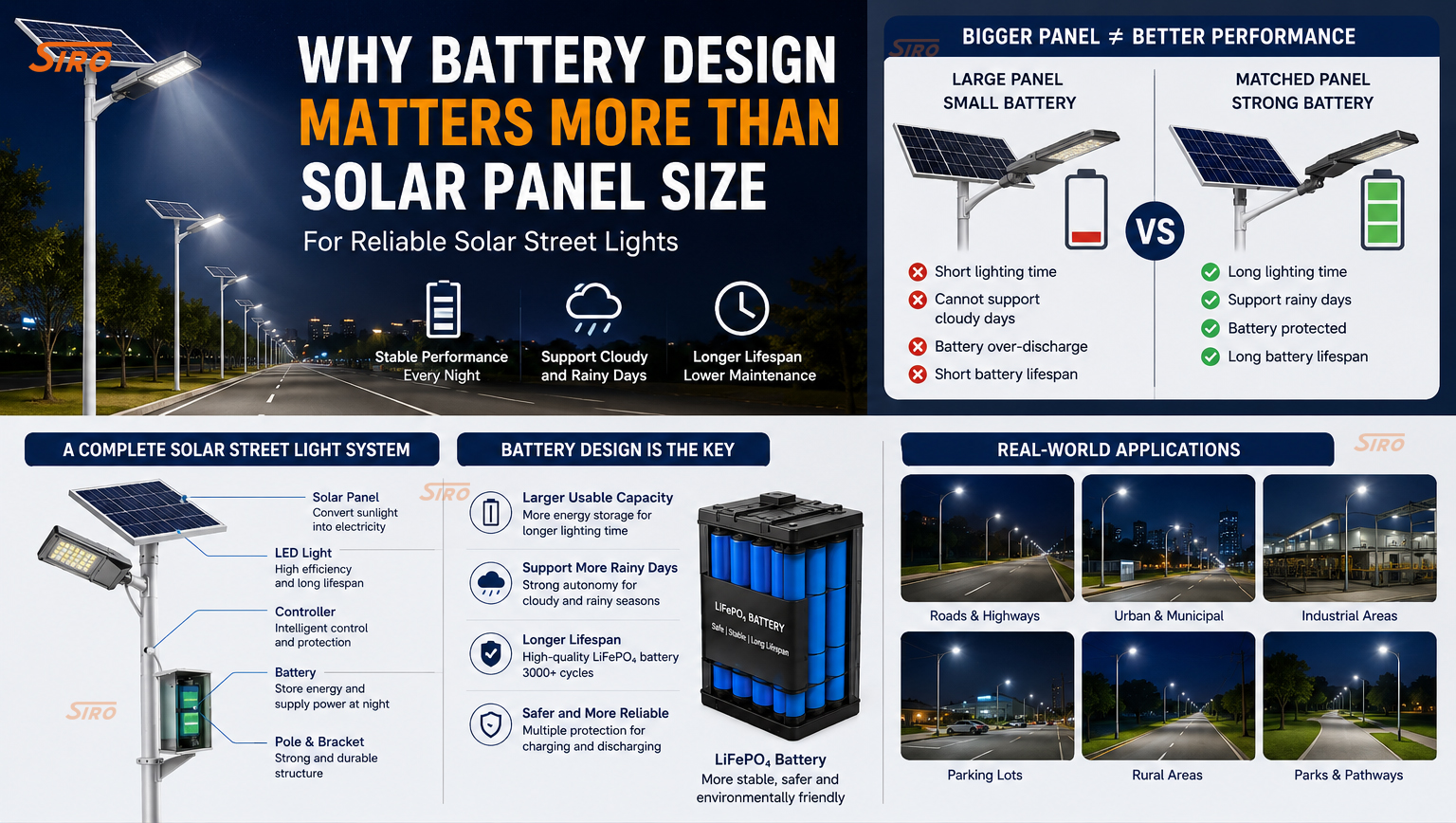
Engineering Insight: Solar Street Light Is a System, Not Just a Lamp
A key takeaway from this project is:
A solar street light is not a single product—it is a complete energy system.
It includes:
- Solar panel (energy generation)
- Battery (energy storage)
- Controller (energy management)
- LED luminaire (lighting output)
Only when all components are properly designed and installed can the system achieve long-term stability and performance.
Conclusion: Proven Performance from Installation to Operation
This project clearly demonstrates that:
✔ Proper installation ensures long-term reliability
✔ Engineering design determines real performance
✔ Solar lighting can successfully replace traditional street lighting in harsh environments
From daytime installation to nighttime illumination, this case reflects a complete, real-world solution for modern road lighting projects.
Looking for Reliable Solar Street Lighting Solutions?
If you are working on road lighting, municipal infrastructure, or urban development projects, choosing the right system design and installation approach is critical.
A well-engineered solar lighting system is not just about saving energy—it is about delivering consistent performance, safety, and long-term value.