Integrated vs. Split Solar Street Lights: A Comparison of Advantages and Disadvantages
A Rational Analysis from the Perspective of Engineering Application and Long-Term Operation
In solar street light projects, “integrated” and “split” are the two most frequently discussed system structures.
Many procurement or project managers often ask at the selection stage: “Which one is better?”
However, from actual engineering experience, this question itself is incomplete.
The real question to answer is not “which one is better,” but “which one is more suitable for this project.”
This article will systematically compare integrated and split solar street lights from multiple engineering dimensions, including structural principles, construction conditions, operational stability, maintenance costs, environmental adaptability, and project risks, to help customers make more rational judgments during the decision-making phase.
I. System Structure Differences: Design Philosophy Determines Applicable Scenarios
Integrated Solar Street Lights
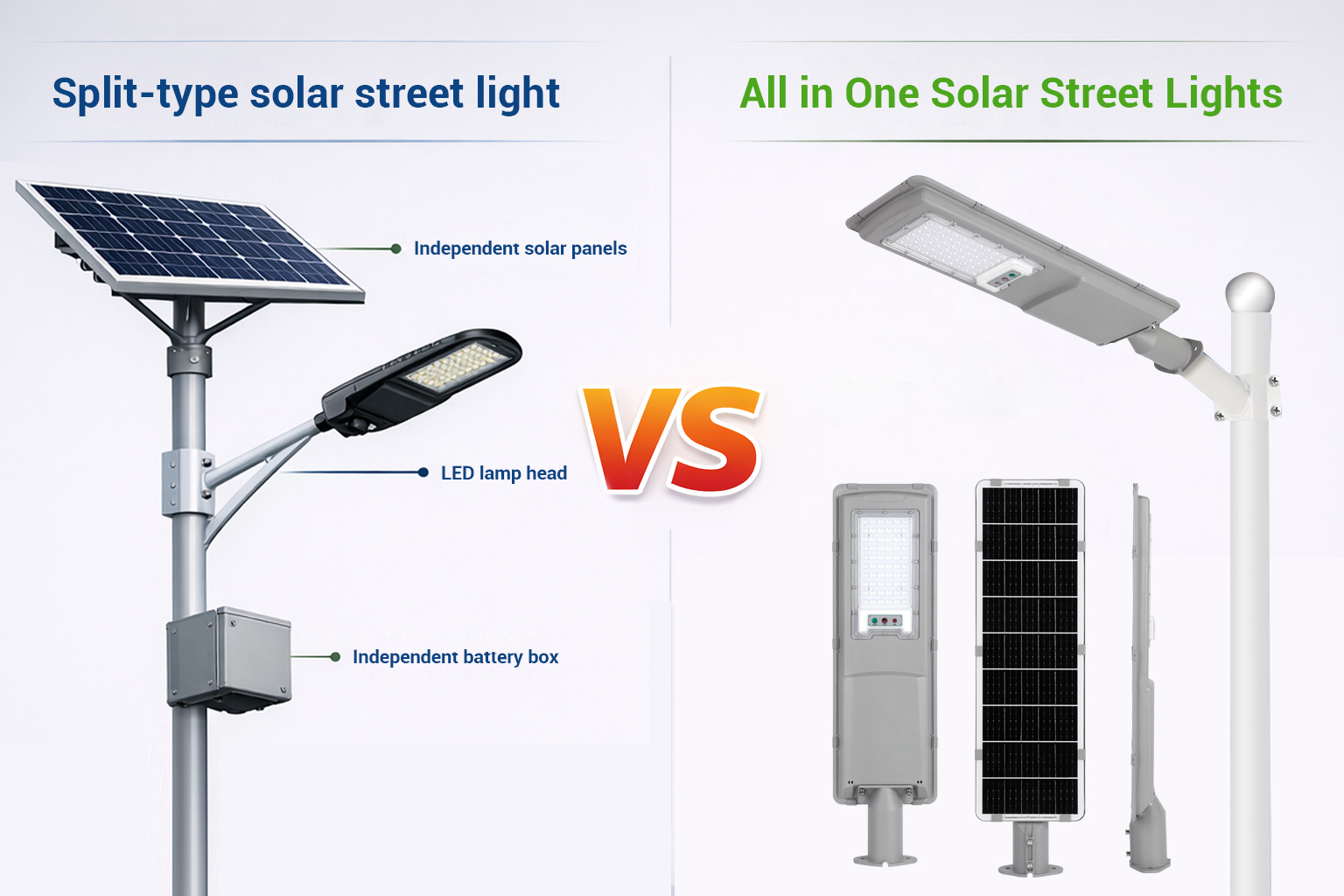
The solar panel, LED light source, controller, and battery are all integrated into the same lamp body structure, forming a highly integrated system.
The design intention is to reduce construction complexity, improve installation efficiency, and lower initial engineering barriers.
Split Solar Street Lights
The solar panel, lamp head, and battery (or controller) are installed separately and connected by cables to form a system.
The design philosophy is more aligned with traditional engineering lighting: the system is more adjustable, the structure is more flexible, and it is suitable for complex or long-term projects.
From a design logic perspective, the two are not a “new replacing old” relationship, but rather two solutions for different project needs.
II. Construction and Installation: Efficiency vs. Controllability
In the installation phase, integrated solar street lights have a clear advantage:
Simple structure
No separate wiring required
Short installation time
Relatively low technical requirements for construction personnel
This makes it very popular in rural roads, community roads, small projects, and rapid deployment scenarios, especially suitable for projects with high labor costs and tight construction schedules.
However, it should be noted that high integration also means that:
Once the installation angle, orientation, and tilt angle are fixed, there is very limited room for later adjustments.
In contrast, the installation process of split solar street lights is more complex:
Requires independent installation of solar panels
Requires wiring connections
Requires higher construction standards
But its advantage lies in:
The solar panel can be freely adjusted in angle and direction according to the actual site conditions, thus achieving more stable power generation efficiency. In projects with complex sunlight conditions, significant obstructions, or high demands for lighting stability, this adjustability is often more important than installation efficiency.
III. Power Generation and Energy Storage Systems: Flexibility Determines Stability
In long-term operation, the true core of solar streetlights lies not in the light fixture itself, but in the stability of the power generation and energy storage system.
Due to volume limitations, integrated systems have:
Relatively smaller solar panel area
Battery capacity is usually limited
System configuration is relatively fixed
This is not a major problem in areas with good sunlight conditions and moderate nighttime lighting needs, but it easily exposes risks in the following scenarios:
Continuous rainy weather
Short daylight hours in winter
High-latitude regions
Roads requiring longer lighting duration
Separate systems, on the other hand, can be configured more flexibly according to project needs:
Higher power solar panels
Higher capacity batteries
Independent optimized control strategies
This makes separate solar streetlights more likely to achieve stable and predictable performance in municipal main roads, industrial parks, port roads, and long-term public lighting projects.
IV. Maintenance and Replacement: Short-Term Convenience vs. Long-Term Costs
In terms of maintenance, the differences between integrated and separate systems gradually become more pronounced over time.
Integrated solar streetlights seem simple to maintain initially, but due to their high integration:
Damage to any core component
Often requires complete disassembly
Repair or replacement costs are concentrated
Especially after the battery enters its degradation cycle, if the battery cannot be replaced separately, the overall maintenance cost will increase significantly.
The advantage of separate systems lies in their modularity:
Batteries, controllers, and lamp heads can be replaced independently
Fault location is clearer
More suitable for long-term operation and maintenance management
From an engineering perspective, the longer the project cycle, the more significant the advantage of separate systems in terms of maintenance costs.
V. Environmental Adaptability: Standardization vs. Customization
In extreme environments, the performance differences between the two systems are particularly evident.
Integrated solar streetlights are more suitable for:
Relatively stable climates
Areas with small temperature differences
Projects with high demands on appearance and overall integrity
However, in the following environmental conditions, separate systems usually have an advantage:
High or low temperature regions
Deserts, coastal areas, high-humidity environments
Projects requiring extremely high system reliability
This is because separate systems can adapt to environmental challenges through structural and configuration adjustments, rather than relying on a single fixed design. VI. From a Project Perspective: There is No “Best,” Only the “Most Suitable”
From an engineering perspective, there is no absolute superiority or inferiority between integrated and split-type solar streetlights.
For small-scale, budget-sensitive projects with short construction periods:
→ Integrated systems offer better cost-effectiveness and efficiency advantages.
For medium-to-large scale, municipal-level, long-term lighting projects:
→ Split-type systems offer advantages in stability and maintainability.
A truly professional selection process should be based on the following core questions:
What is the expected lifespan of the project?
What is the tolerance level for lighting stability?
Is maintenance convenient when the system malfunctions?
Are the environmental conditions complex or uncontrollable?
Only after these questions are clearly answered does the choice of system structure become truly meaningful.
Conclusion: Rational Selection is Responsible for the Project
Solar streetlights are not ordinary “plug-and-play” products, but rather long-term operating engineering systems.
Whether choosing integrated or split-type systems, the essence is to strike a balance between cost, efficiency, stability, and risk.
From an engineering perspective, understanding the differences, accepting the differences, and rationally matching project needs are far more important than blindly pursuing the “latest structure.”
For any customer who hopes for long-term stable operation of their project,
the correct system selection is an integral part of project success.