Why Can Two Similar-Looking LED Street Lights Differ in Price by 30%?
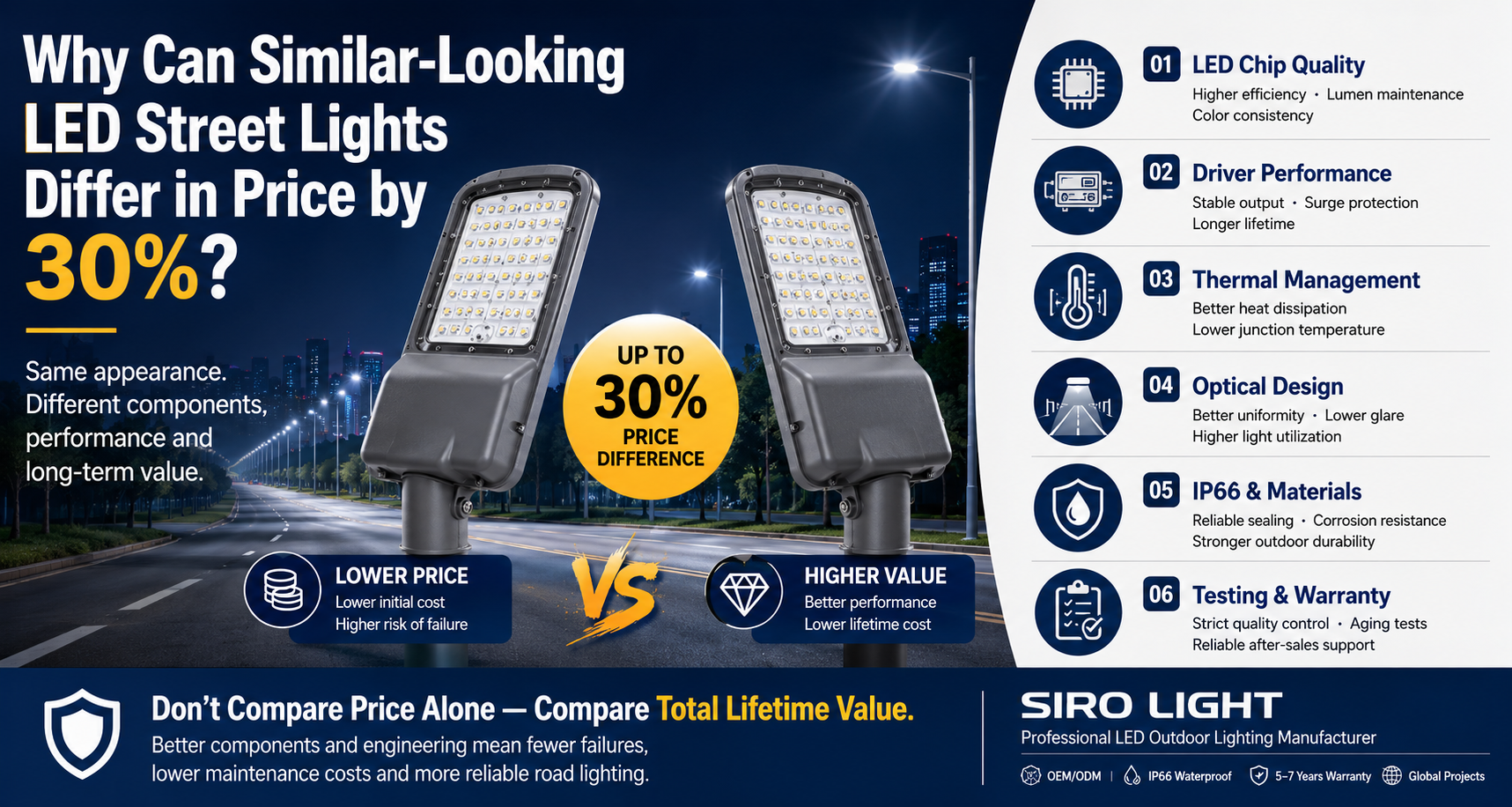
When purchasing LED street lights, many buyers face the same question: two lamps may look almost identical in shape, size, wattage, and even basic specifications, but the price difference can reach 20–30% or more.
Why?
The answer is that the real value of an LED street light is not only in its appearance. The major differences are often hidden inside the luminaire — in the LED chips, driver, thermal design, optical system, waterproof structure, manufacturing process, testing standards, and after-sales support.
1. LED Chip Quality Affects Long-Term Performance
Two 100W LED street lights may use completely different LED chips.
Higher-quality LED chips generally offer better luminous efficiency, more stable color consistency, lower thermal resistance, and slower lumen depreciation. Lower-cost chips may provide similar brightness when the lamp is new, but their light output can decline faster after long-term operation.
For road lighting projects, buyers should not only ask:
“How many lumens does this lamp produce?”
A more important question is:
“How much light output can it maintain after thousands of operating hours?”
This is why LED chip quality and lumen maintenance performance have a direct impact on product cost.
2. The LED Driver Can Create a Large Price Difference
The driver is one of the most important components inside an LED street light.
A high-quality driver normally uses more reliable capacitors, stable constant-current control, surge protection, over-temperature protection, and better electrical components.
In contrast, lower-cost drivers may reduce the initial product price, but they can also increase the risk of flickering, unstable output, premature failure, or damage caused by voltage fluctuations.
⚡ For outdoor lighting projects, especially in areas with unstable power grids, driver reliability is critical.
A cheaper driver may save several dollars during purchasing, but one failure can create much higher costs in replacement labor, transportation, and maintenance.
3. Similar Housing Does Not Mean Similar Heat Dissipation
Many LED street lights look similar from the outside, but their internal thermal designs can be very different.
Heat dissipation depends on several factors:
• Aluminum quality and housing thickness
• Heat sink structure
• PCB thermal conductivity
• Thermal interface material
• Contact area between the LED board and housing
• Internal airflow and component layout
If heat cannot be transferred efficiently, the LED junction temperature rises.
Higher junction temperature accelerates LED lumen depreciation and also puts more stress on the driver and electronic components.
🌡️ Better thermal management means more stable brightness and a longer service life.
This is one of the most important reasons why two similar-looking street lights can have different production costs.
4. Optical Design Determines Real Road Lighting Quality
Street lighting is not simply about making a lamp brighter.
Professional LED street lights need to distribute light correctly across the road.
Different lenses and optical designs can produce completely different lighting results, even when the total lumen output is similar.
A low-cost luminaire may have high lumens but poor light distribution, causing:
• Dark areas between poles
• Excessive glare
• Light wasted outside the road
• Poor uniformity
• Lower visual comfort for drivers
A professional manufacturer should provide IES files, photometric test reports, and lighting simulations according to road width, pole height, spacing, and project requirements.
For engineering projects, good optical design can reduce unnecessary wattage while still achieving the required lux level and uniformity.
5. IP66 Is Not Just a Label
Many LED street lights are marked IP66, but the actual long-term waterproof performance can vary greatly.
Reliable waterproofing depends on the complete mechanical design, including:
• Silicone gasket quality
• Housing machining accuracy
• Cable glands
• Screws and sealing pressure
• Driver compartment structure
• Assembly consistency
Poor sealing may not cause immediate failure.
However, after repeated exposure to rain, humidity, temperature changes, and dust, moisture may gradually enter the luminaire and damage the LED board or driver.
For outdoor projects, stable IP66 protection requires both good structural design and strict production control.
6. Testing and Quality Control Also Have a Cost
Another major price difference comes from the manufacturing and testing process.
A reliable LED street light manufacturer normally carries out multiple inspections, such as:
✅ Incoming material inspection
✅ Electrical safety testing
✅ Power and current testing
✅ Waterproof testing
✅ Aging testing
✅ Surge protection testing
✅ Photometric testing
✅ Final appearance inspection
Some low-cost suppliers may reduce or simplify these processes to lower production costs.
The lamp may still look good when delivered, but the quality consistency between different production batches can become a serious problem.
For distributors, contractors, and project companies, consistent quality is often more important than saving a small amount on each lamp.
7. Warranty and Technical Support Are Also Part of the Price
The value of an LED street light does not end when the product leaves the factory.
Professional suppliers may also provide:
• OEM/ODM customization
• IES files and lighting simulations
• Project selection support
• Customized wattage or color temperature
• Spare parts
• Warranty replacement
• Technical troubleshooting
• Long-term after-sales support
These services require engineering experience, testing capability, inventory management, and technical staff.
Therefore, when comparing quotations, buyers should not only compare the lamp itself.
They should compare the complete solution.
Conclusion: Do Not Compare LED Street Lights Only by Appearance
Two LED street lights may look almost identical, but the internal quality can be very different.
The price difference may come from:
LED chips + driver + thermal design + optical system + waterproof structure + quality control + testing + warranty + manufacturer support.
A 30% lower purchase price may look attractive at the beginning, but if the product has a higher failure rate, faster lumen depreciation, poor road lighting performance, or frequent maintenance requirements, the total project cost can be much higher.
For professional street lighting projects, the most important question is not:
“Which LED street light is cheaper?”
The better question is:
“Which lighting solution offers the lowest risk, stable performance, and the best total cost over the entire project lifetime?”