Why Are Solar Street Light Prices So Different? The Key Configurations Behind the Cost
When buyers start sourcing solar street lights, one question comes up again and again: why do prices vary so much?
Some suppliers offer very low prices, while others quote significantly more for products that seem similar at first glance. To many customers, the products may look almost the same in photos, so the price gap can be confusing.
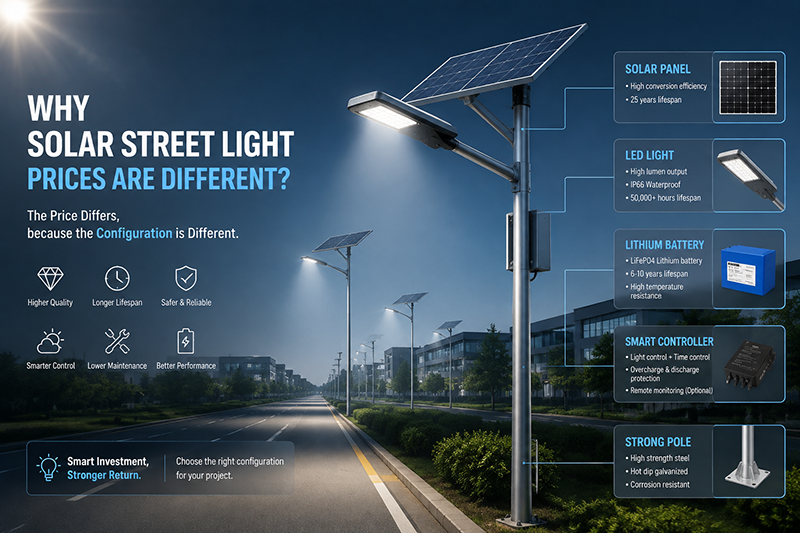
The truth is simple: a solar street light is not just a lamp. It is a complete off-grid lighting system made up of a solar panel, battery, LED light source, controller, housing structure, and lighting design. Even if two products look similar on the outside, their internal configuration, performance, lifespan, and maintenance cost can be completely different.
That is why the price difference is often not about appearance. It is about component quality, system design, real performance, and long-term reliability.
If you only compare price, you may end up choosing a low-cost product that creates higher maintenance costs later. But if you understand the key configurations behind the quotation, you can make a much more professional purchasing decision.
1. The Real Reason Behind the Price Difference
Solar street lights are system products, not single components.
A quotation should not be judged only by the listed wattage or by how the lamp looks in a catalog.
For example, two suppliers may both offer a “100W solar street light,” but that does not mean they are offering the same product. One may use a smaller solar panel, lower battery capacity, and lower light output. Another may use a high-efficiency monocrystalline panel, a larger lithium battery, premium LED chips, and a more stable MPPT controller.
In this case, the second product will naturally cost more. However, it will also usually deliver:
- longer lighting hours,
- better brightness consistency,
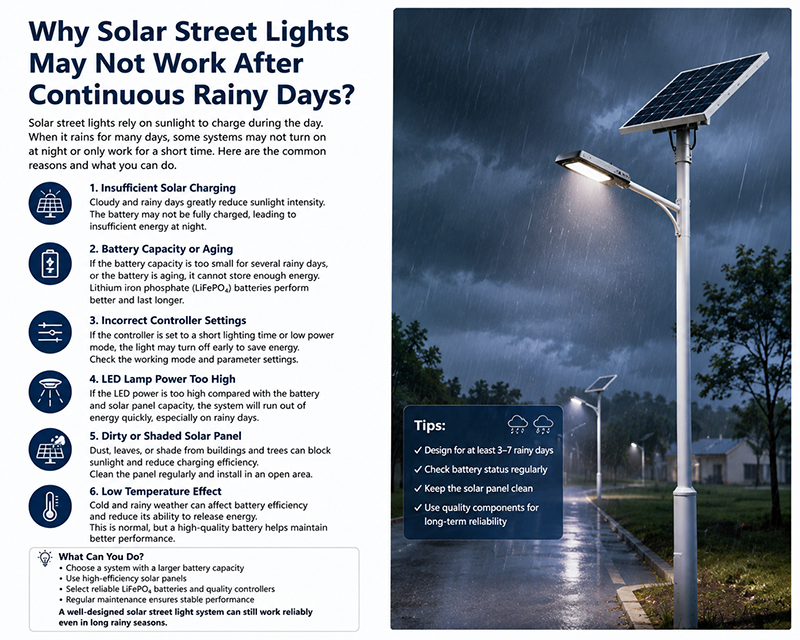
- better performance in cloudy or rainy weather,
- lower failure rate,
- and a longer service life.
So when solar street light prices vary widely, the key question is not “who is cheaper?” but rather “what exactly is included in the configuration?”
2. Solar Panel Quality and Power Make a Big Difference
The solar panel is the power source of the whole system. During the day, it converts sunlight into electricity and charges the battery for night-time lighting.
At first glance, one solar panel may look similar to another, but the actual performance can differ a lot. Price differences usually come from:
- monocrystalline vs. lower-efficiency panel types,
- actual wattage and charging capability,
- cell quality and conversion efficiency,
- encapsulation technology,
- and long-term outdoor durability.
If the solar panel is undersized, the battery cannot be fully charged, especially in areas with unstable sunshine. As a result, the lamp may not work through the night or may fail after several cloudy days.
A low quotation often includes a smaller or lower-grade panel. A more professional quotation will match the solar panel size to the local sunshine conditions, battery capacity, lighting hours, and project requirements.
This is one major reason why solar street light prices are different.
3. Battery Type and Real Capacity Are Critical
The battery is one of the most important cost factors in a solar street light system. It directly affects:
- how many hours the lamp can work each night,
- how many backup days it can support during rainy weather,
- how long the system lasts,
- and how much maintenance will be needed.
In the current market, common battery options include lead-acid batteries, gel batteries, and lithium batteries. For most modern outdoor projects, lithium batteries, especially LiFePO4 batteries, are preferred because they offer better cycle life, higher safety, and more stable performance.
The problem is that some low-cost products use smaller batteries than needed, or even list battery capacity that does not match the real configuration. On paper, the lamp may look powerful. In reality, it may only perform well for a short time before lighting hours become shorter and brightness drops.
A properly configured solar street light should have battery capacity calculated according to:
- local solar radiation conditions,
- required lighting hours per night,
- number of backup days,
- and system power consumption.
Better batteries cost more, but they also reduce after-sales problems and improve project reliability.
4. LED Chips and Real Luminous Efficiency Affect Both Price and Performance
Many buyers focus only on wattage, but wattage alone does not tell the full story. In street lighting, what really matters is luminous efficiency, beam distribution, and lighting performance on the road.
Two lamps with the same nominal wattage may perform very differently if one uses lower-quality LED chips and poor optical design.
The key cost factors here include:
- LED chip brand and quality,
- actual lumen output,
- luminous efficiency per watt,
- light decay performance,
- optical lens design,
- and heat dissipation structure.
A low-cost solar street light may claim high wattage but still provide limited effective brightness. A higher-quality product may have better LED chips and more professional road lighting optics, giving better road uniformity and stronger visible lighting performance.
For project buyers, that matters much more than a large number printed in the specification.
5. Controller Technology: PWM vs. MPPT
The controller is the brain of the solar street light system. It manages charging, discharging, battery protection, and sometimes dimming logic as well.
This component is often invisible to the buyer, but it can make a major difference in price and reliability.
Low-end products often use standard PWM controllers, which are cheaper but less efficient. Better systems often use MPPT controllers, which can track solar energy more efficiently and improve charging performance, especially in regions with changing sunlight conditions.
A higher-quality controller may also include:
- overcharge and over-discharge protection,
- intelligent dimming,
- time-based power control,
- temperature compensation,
- surge protection,
- and motion sensor integration.
A supplier that uses a better controller usually offers a more stable system, but naturally at a higher price. That higher price reflects a better-performing product, not just a more expensive quote.
6. Housing Material, Structure, and IP Rating Also Matter
Solar street lights work outdoors all year long. They must resist heat, rain, dust, humidity, and in some regions even coastal corrosion.
That is why structural quality is a major part of the cost.
A good solar street light usually includes:
- die-cast aluminum housing,
- effective heat dissipation design,
- anti-corrosion treatment,
- strong mounting brackets,
- high waterproof protection such as IP66,
- and a durable structure for long-term outdoor use.
Lower-cost products may reduce cost by using thinner materials, weaker sealing structures, lower-grade paint treatment, or poor internal assembly quality. These issues may not be visible in a quotation photo, but they can quickly lead to water ingress, overheating, rust, or shortened service life.
For engineering buyers, these risks translate directly into future maintenance cost.
7. Project Design Requirements Change the Quotation
Another common reason for price differences is that not all suppliers are quoting based on the same project assumptions.
Many buyers ask for “the price of a solar street light” without providing the project details. In reality, a professional quotation depends on several technical conditions, such as:
- road width,
- pole height,
- installation spacing,
- lighting hours per night,
- required backup days,
- local weather and sunshine conditions,
- and application type such as highway, village road, industrial park, or residential area.
Different projects require different system designs. A solution for a rural road is not the same as a solution for a municipal road or a commercial area.
That means two suppliers may both quote a solar street light, but one is offering a basic product while the other is offering a real project-matched solution. Naturally, the prices will be different.
8. Why Are Some Solar Street Lights Extremely Cheap?
If a solar street light price seems unusually low, buyers should be careful. In many cases, the low price comes from one or more of the following issues:
1) Overstated specifications
Some products list higher wattage, larger battery capacity, or stronger solar panels than what is actually used. The quotation looks attractive, but the real performance does not match.
2) Undersized battery
A lamp may claim 10 to 12 hours of lighting, but the battery is too small to support that performance under real conditions.
3) Low-grade LED chips and components
The lamp may work at the beginning, but brightness drops quickly and the failure rate becomes higher over time.
4) Weak waterproof and structure design
Cheap products often fail because of poor sealing, poor heat dissipation, or corrosion issues in outdoor environments.
5) Lack of testing
Professional manufacturers normally carry out aging tests, waterproof tests, charging/discharging tests, and photometric verification. Low-cost products may skip part of this process to reduce cost.
This is why a lower purchase price does not always mean a lower total cost.
9. What Should Buyers Check Before Comparing Prices?
If you are sourcing solar street lights for municipal roads, industrial parks, communities, or overseas projects, do not compare quotations based on price alone.
Instead, confirm the following points:
- What is the actual solar panel wattage?
- What battery type is used, and what is the real battery capacity?
- What is the actual LED luminous efficiency?
- Is the controller PWM or MPPT?
- How many backup days can the system support?
- Is the protection level IP66?
- Can the supplier provide lighting simulation or IES files?
- Has the product passed aging, waterproof, and quality testing?
- What warranty is offered?
- Does the supplier have real project experience and OEM/ODM capability?
These questions will quickly show the difference between a supplier that only offers a low price and one that offers a reliable lighting solution.
10. The Lowest Price Is Not the Best Value
In solar street lighting projects, the lowest initial cost is not always the smartest option. What matters more is the total project cost over time.
A cheap but unstable product may lead to:
- poor brightness,
- short lighting time,
- failure during rainy days,
- frequent battery replacement,
- higher maintenance cost,
- and customer complaints.
A properly designed and well-tested solar street light may cost more at the beginning, but it usually provides:
- more stable lighting performance,
- longer service life,
- fewer maintenance issues,
- better project acceptance,
- and stronger end-user satisfaction.
For serious project buyers, this is where the real value lies.
Conclusion
So, why are solar street light prices so different?
The answer is clear: the difference comes from configuration, component quality, design capability, testing standards, and long-term reliability.
If you only compare products by appearance, they may seem similar. But once you look at the solar panel, battery, LED chips, controller, housing material, IP rating, and lighting design, you will quickly understand why one solution costs more than another.
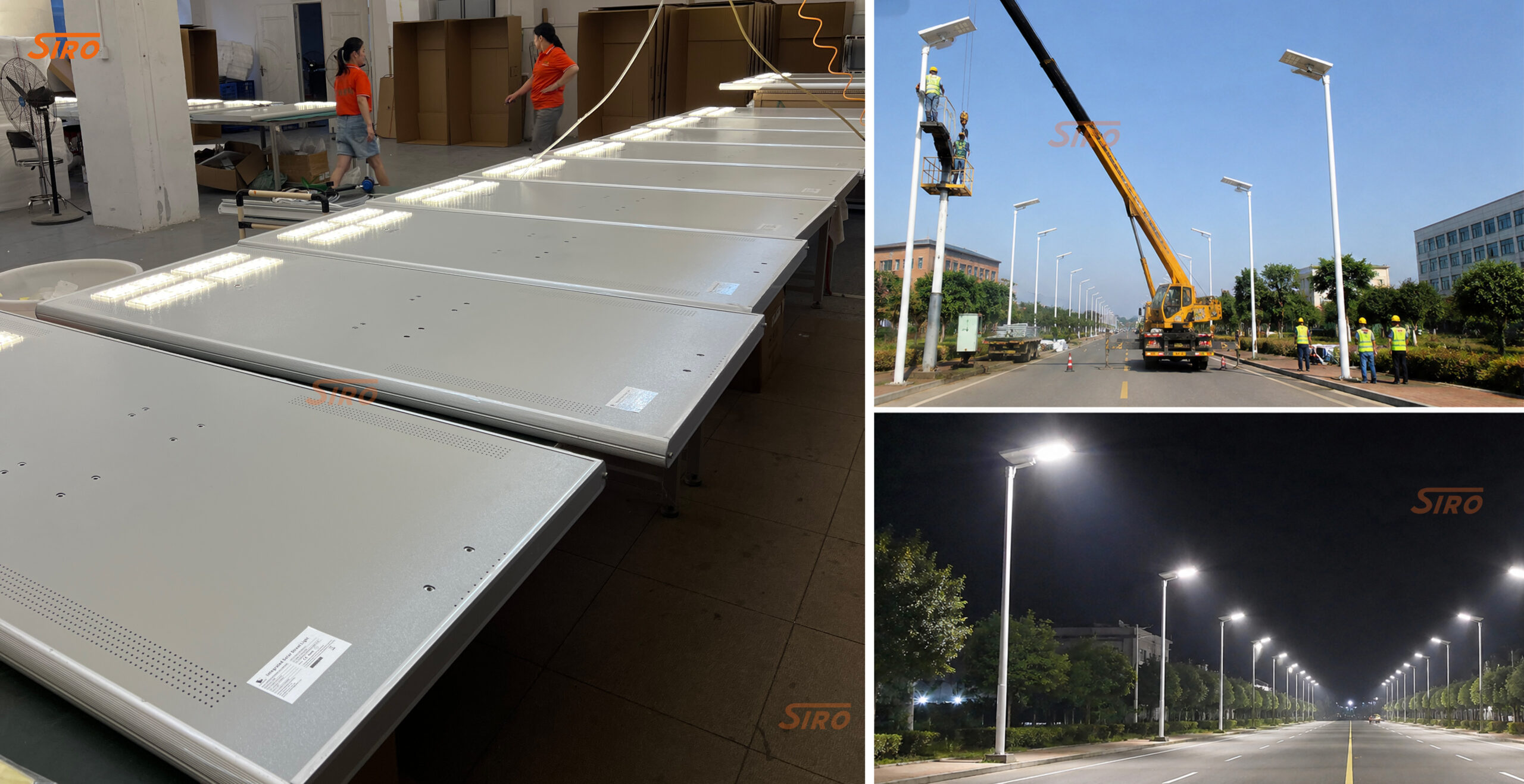
For professional buyers, the goal should not be to find the cheapest supplier. The goal should be to find a manufacturer that understands project requirements, offers properly matched configurations, and can deliver a reliable solar street light system with stable quality.
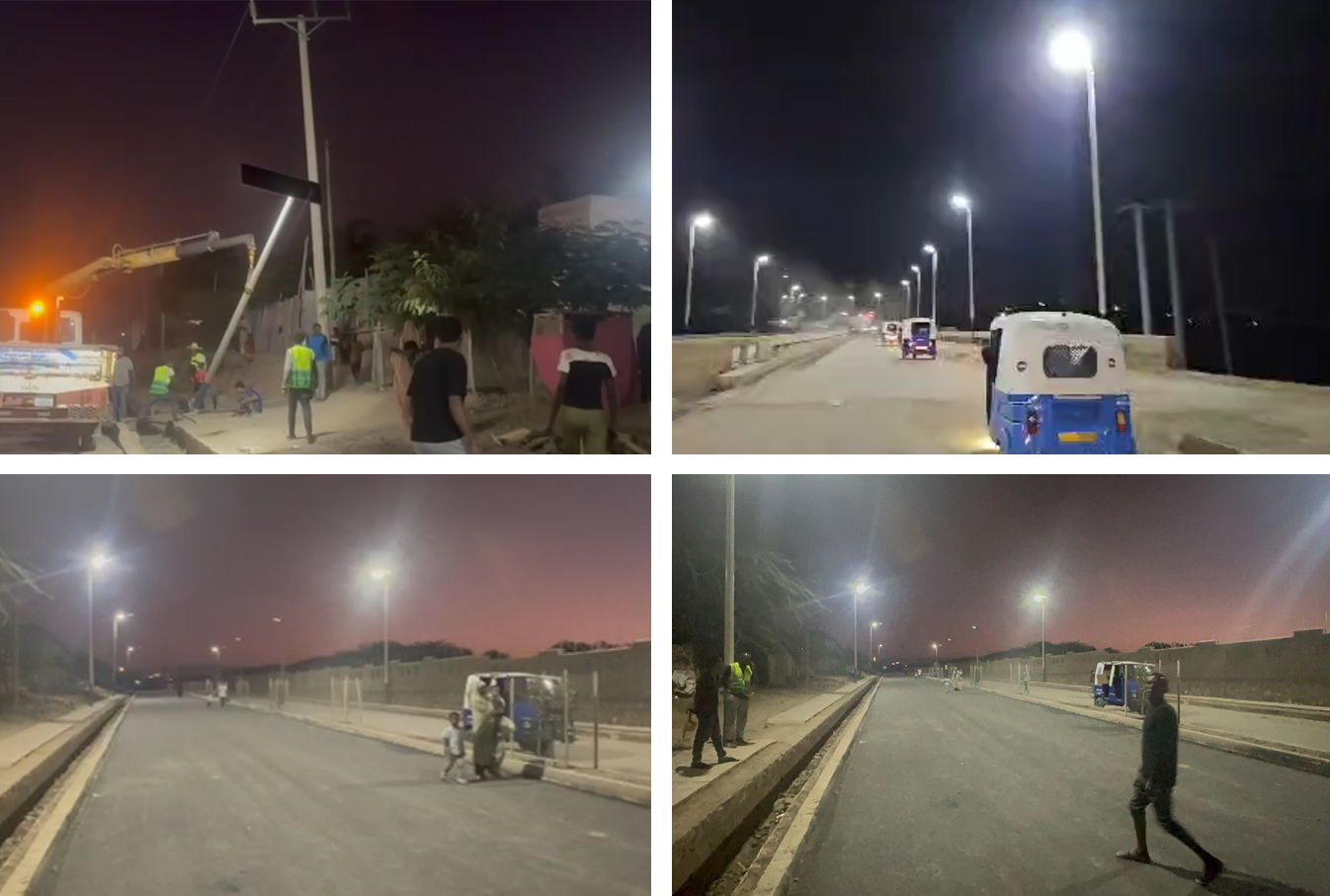
At SIRO Light, we support customers with project-based solar street light solutions, OEM/ODM service, professional product selection, and technical support. If you have a road lighting project and would like a more accurate recommendation, feel free to contact us with your installation height, road width, lighting hours, and local project conditions.
FAQ
1. Why do solar street lights with the same wattage have different prices?
Because wattage alone does not define the full system. The solar panel size, battery type, LED quality, controller technology, and housing structure can all be different.
2. Which battery is better for solar street lights?
For most modern projects, LiFePO4 batteries are a better option because of their long cycle life, higher safety, and stable outdoor performance.
3. Is a cheaper solar street light always a bad choice?
Not always, but very low prices often mean reduced configuration or lower-quality components. Buyers should check the full specification carefully.
4. Why is MPPT controller better than PWM?
MPPT controllers generally offer better charging efficiency and improved energy use, especially in areas with unstable sunlight conditions.
5. What is the most important thing to compare when buying solar street lights?
The most important thing is to compare the full system configuration and whether it matches your project requirements, not just the unit price.