What Tests Should an LED Street Light Pass Before Leaving the Factory?
For an LED street light used in a road lighting project, good performance should not depend only on what is written on the specification sheet.
Before the luminaire is packed and shipped, a professional LED street light manufacturer should verify whether the product performs correctly under real electrical, thermal, mechanical, and outdoor operating conditions.
For distributors, contractors, municipal projects, and lighting engineering companies, factory testing directly affects several important issues:
✓ Product reliability
✓ Road lighting performance
✓ Installation safety
✓ Failure rate
✓ Maintenance cost
✓ Warranty risk
✓ Long-term project reputation
So, what tests should an LED street light go through before leaving the factory?
The answer involves much more than simply switching the lamp on for a few minutes.
Why Factory Testing Is Important for LED Street Lights
Street lights usually operate outdoors for long periods every night.
Compared with indoor lighting products, they may face much harsher conditions, including:
- Rain and dust
- High and low ambient temperatures
- Voltage fluctuations
- Lightning-related electrical surges
- Long operating hours
- Vibration during transportation and installation
- Continuous thermal cycling
Once a street light is installed several meters above the road, replacing or repairing it becomes much more expensive than testing it properly in the factory.
A single failure may involve:
→ A maintenance vehicle
→ Installation workers
→ Traffic management
→ Replacement components
→ Additional labor cost
→ Customer complaints
For this reason, factory quality control should focus on finding potential problems before the luminaires reach the project site.
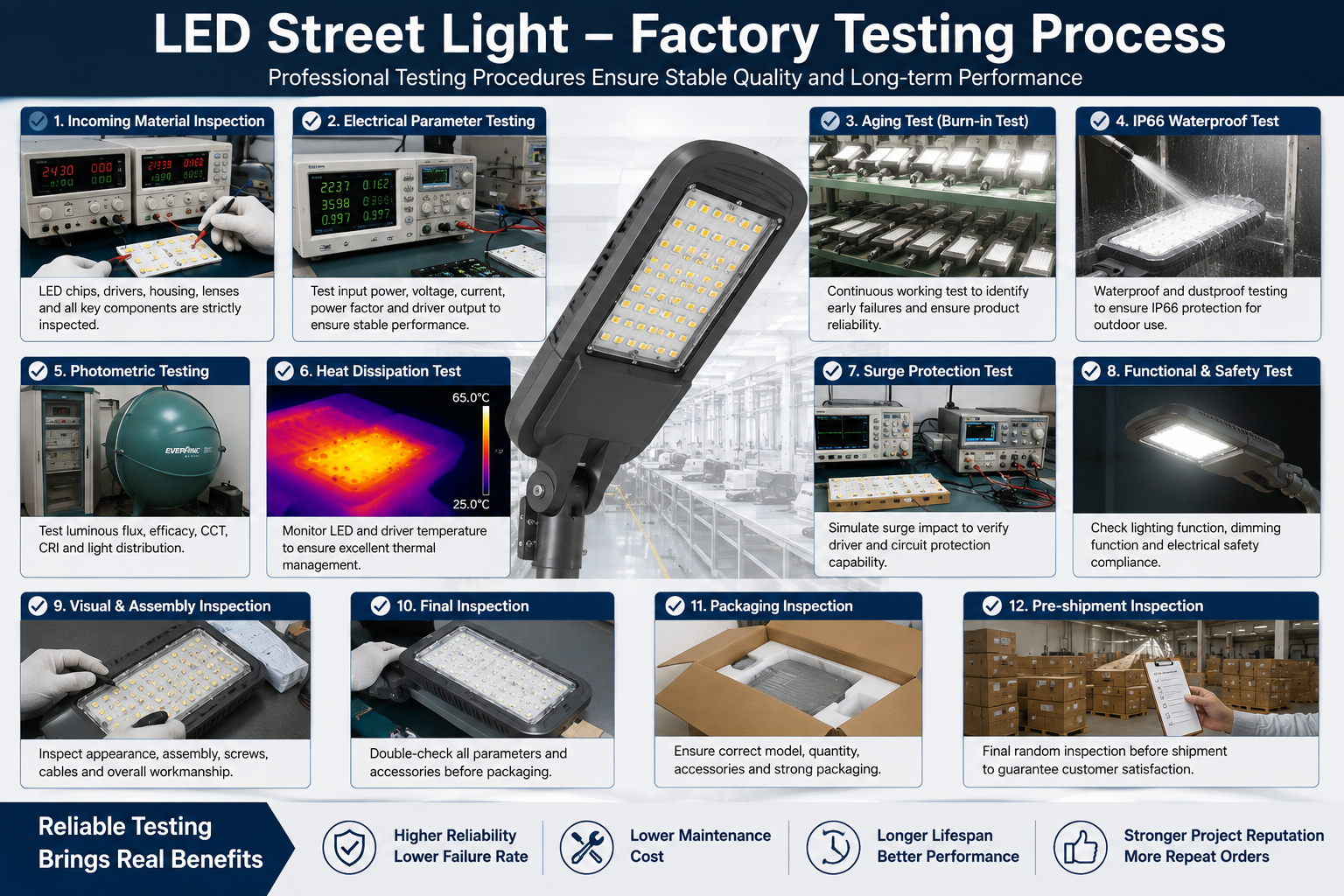
1. Incoming Material Inspection
Good quality control begins before the LED street light is assembled.
The factory should first inspect the key components and raw materials used in production.
Important parts normally include:
LED Chips
The LED source directly affects lumen output, efficiency, color consistency, and long-term performance.
The factory may check:
✓ LED model
✓ Color temperature
✓ Forward voltage
✓ Luminous characteristics
✓ Supplier batch consistency
LED Driver
The driver is one of the most important electronic components inside an LED street light.
Incoming inspection may include:
✓ Driver model
✓ Input voltage range
✓ Output voltage and current
✓ Power rating
✓ Power factor
✓ Supplier and batch information
Aluminum Housing
The housing is not only the external structure of the luminaire. It also plays an important role in heat dissipation.
The factory should inspect:
✓ Casting quality
✓ Surface finish
✓ Structural dimensions
✓ Heat sink condition
✓ Mounting interface
✓ Coating quality
Lens, Glass and Sealing Components
Optical and waterproof components should also be checked carefully.
These may include:
- Optical lenses
- Tempered glass
- Silicone gaskets
- Waterproof connectors
- Screws and fasteners
- Cable glands
Poor material control at this stage can create problems later even if the final assembly looks normal.
2. Visual and Assembly Inspection
After assembly, each LED street light should be checked for obvious manufacturing defects.
The inspection may cover:
✓ Housing surface condition
✓ Screws and fasteners
✓ Lens installation
✓ Glass installation
✓ Rubber sealing position
✓ Cable connection
✓ Waterproof connector installation
✓ Product label
✓ Logo and OEM marking
✓ Mounting bracket condition
For OEM and ODM projects, the factory should also confirm that customized labels, packaging, product codes, wattage markings, and customer branding match the approved order.
⚠ A small assembly mistake can sometimes create a large field problem.
For example, a poorly positioned sealing gasket may affect waterproof performance even when the housing itself is well designed.
3. Electrical Parameter Testing
Electrical testing is one of the most important production-line inspections.
After the LED street light is assembled, its actual operating parameters should be checked.
Typical measurements may include:
✓ Input Power
The actual power consumption should be compared with the specified rated wattage.
For example, a 100W LED street light should operate within the manufacturer’s defined tolerance range.
✓ Input Voltage and Current
The luminaire should operate correctly within its specified voltage range.
Depending on the destination market, street lights may be designed for different electrical systems.
✓ Power Factor
Power factor is especially important for commercial, industrial, and municipal lighting projects.
A suitable driver should provide stable electrical performance under the required operating conditions.
✓ Driver Output
The output voltage and current should match the LED module design.
Abnormal current can negatively affect LED lifetime, temperature, and lumen maintenance.
4. Electrical Safety Testing
An LED street light is connected directly to an electrical system, so electrical safety cannot be ignored.
Depending on the product design and applicable certification requirements, manufacturers may perform or verify tests such as:
- Hi-pot / dielectric strength testing
- Insulation resistance testing
- Ground continuity testing
- Leakage current testing
These tests help confirm that the luminaire is properly insulated and electrically safe.
For Class I luminaires, reliable grounding is especially important because the metal housing must be correctly connected to protective earth.
⚠ The exact electrical safety test requirements should follow the applicable product standard and destination-market certification requirements.
5. LED Street Light Aging Test
The aging test, also called a burn-in test, is one of the most important production tests before shipment.
Instead of immediately packing the newly assembled street lights, the factory operates them continuously for a defined period.
Why?
Because some component or assembly problems may not appear immediately after the lamp is switched on.
During aging, technicians can observe whether there are problems such as:
✓ Flickering
✓ Driver failure
✓ Abnormal power fluctuation
✓ LED module failure
✓ Loose electrical connections
✓ Color abnormalities
✓ Excessive temperature
Aging testing helps identify early failures before the products are delivered to customers.
For project customers ordering hundreds or thousands of LED street lights, this step can significantly reduce the risk of receiving defective units.
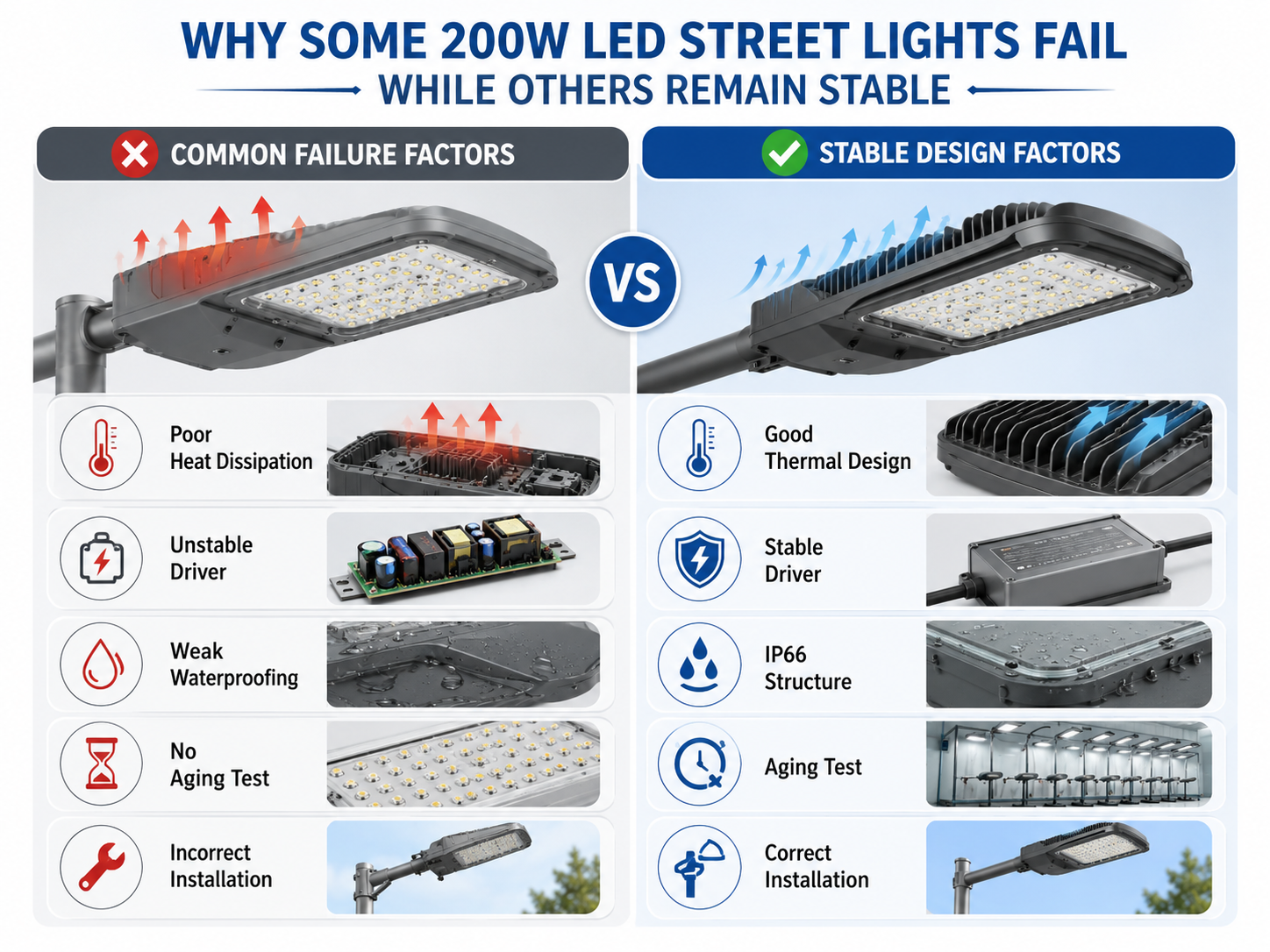
6. Thermal and Heat Dissipation Inspection
Heat management has a direct relationship with the reliability of an LED street light.
During operation, the LED chips and driver continuously generate heat.
If this heat is not transferred efficiently, excessive internal temperature may accelerate:
- LED lumen depreciation
- Driver aging
- Electronic component failure
- Color shift
- Sealing material degradation
A well-designed street light normally uses an aluminum housing and a carefully engineered heat dissipation structure.
During product development and quality validation, manufacturers may measure temperatures at critical points such as:
→ LED board
→ LED solder point area
→ Driver compartment
→ Aluminum housing
The test helps engineers verify whether the thermal design can keep important components within an acceptable operating temperature range.
Why Is Heat Dissipation So Important?
LED lifetime is not determined by the LED chip alone.
Even a high-quality LED chip can experience reduced lifetime if the thermal design of the luminaire is poor.
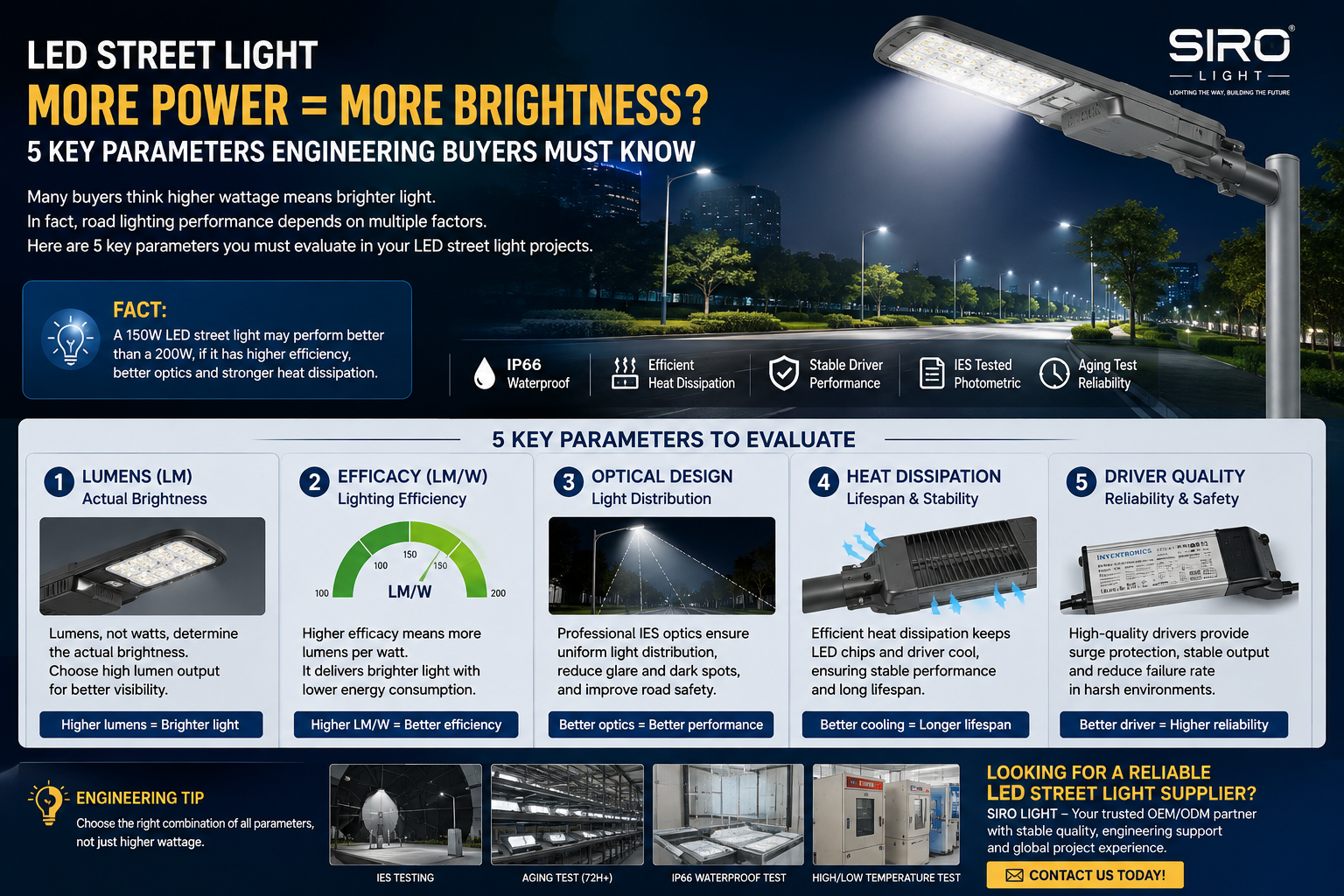
This is why professional buyers should look beyond wattage and lumen output when comparing LED street light suppliers.
7. IP66 Waterproof and Dust Protection Testing
Outdoor street lights are constantly exposed to the environment.
For many road lighting applications, IP66 protection is a common requirement.
IP66 indicates a high level of protection against:
✓ Dust ingress
✓ Powerful water jets
However, seeing “IP66” on a specification sheet is not enough.
The waterproof performance depends on the complete luminaire design, including:
- Housing structure
- Glass or lens sealing
- Silicone gasket
- Cable gland
- Driver compartment
- Screws
- Assembly accuracy
During product validation, an LED street light manufacturer may perform IP protection testing according to the applicable test method.
Factories may also include waterproof inspection or sample verification as part of production quality control.
Why Can Waterproof Problems Occur?
Even when the product design has passed an IP test, incorrect assembly can still create leakage risk.
For example:
→ A damaged gasket
→ Incorrect gasket positioning
→ Loose screws
→ Improper cable gland installation
can reduce the effectiveness of the sealing system.
Therefore, good IP66 performance depends on both product design and manufacturing consistency.
8. Photometric Testing
A street light is ultimately designed to illuminate a road.
Therefore, lighting performance must also be verified.
Photometric testing can evaluate parameters such as:
✓ Luminous flux
✓ Luminous efficacy
✓ Color temperature
✓ Color rendering
✓ Light distribution
✓ Beam characteristics
For road lighting projects, the distribution curve is particularly important.
Two LED street lights with the same wattage and similar lumen output can create completely different results on the road if they use different optical lenses.
9. IES Photometric File Verification
Professional street lighting projects often require an IES file.
An IES file describes how the luminaire distributes light in different directions.
Lighting designers can import this file into software such as DIALux to simulate a project.
The simulation may help evaluate:
- Average illuminance
- Minimum illuminance
- Uniformity
- Road coverage
- Pole spacing
- Pole height
- Installation angle
- Number of luminaires required
For example, a customer may provide:
Pole height: 10 m
Road width: 12 m
Pole spacing: 35 m
Installation: Single side
The manufacturer can use suitable photometric data to evaluate whether the selected street light can meet the expected road lighting performance.
This is much more reliable than simply saying:
“100W is enough for a 10-meter pole.”
Road lighting should be based on photometric performance and project conditions, not wattage alone.
10. Surge Protection Testing and Verification
Street lighting systems are particularly exposed to electrical surge risks.
Surges may be caused by:
- Lightning-related events
- Grid switching
- Electrical disturbances
- Long outdoor power lines
A strong surge can damage the LED driver or other electronic components.
For this reason, outdoor LED street lights are often designed with surge protection.
Depending on the project, different surge protection levels may be required.
Professional suppliers should confirm the required protection level according to:
✓ Local market requirements
✓ Project specifications
✓ Driver configuration
✓ Electrical environment
For areas with frequent thunderstorms or unstable grids, surge protection deserves particular attention.
11. Switching and Functional Testing
The street light should also be tested for normal switching and operational behavior.
A functional inspection can verify whether:
✓ The lamp switches on normally
✓ There is no flicker
✓ All LEDs operate correctly
✓ The driver starts correctly
✓ Dimming functions operate normally
✓ Smart-control functions respond correctly
If the street light includes additional functions such as:
- 0-10V dimming
- DALI control
- Photocell
- Timer dimming
- Smart street lighting controller
these functions should also be checked according to the order specification.
12. Mechanical and Structural Inspection
Street lights are installed on poles and remain outdoors for many years.
The mechanical structure therefore needs to be stable.
Inspection may include:
✓ Mounting bracket condition
✓ Screws and locking points
✓ Pole-entry dimensions
✓ Adjustable angle mechanism
✓ Housing closure
✓ Cable protection
For adjustable street lights, technicians should verify whether the mounting angle can be correctly fixed.
For project orders, the pole diameter and mounting configuration should also be confirmed before mass production.
13. Additional Reliability Tests for Selected Projects
Not every test needs to be performed on every single production unit.
This distinction is important.
Some tests are normally carried out during product development, certification, type testing, or periodic sample inspection rather than on 100% of shipped luminaires.
Depending on the project and destination market, additional tests may include:
Salt Spray Testing
Important for coastal, marine, or highly corrosive environments.
It helps evaluate the corrosion resistance of housing coatings, screws, and metal components.
Vibration Testing
Useful for evaluating mechanical reliability during transportation or certain installation conditions.
Temperature Testing
High- and low-temperature tests can help verify operation under more demanding environmental conditions.
UV Resistance Evaluation
Outdoor components such as plastic lenses, cables, and sealing materials may require consideration of long-term UV exposure.
Coating and Surface Tests
These tests can help evaluate paint adhesion, corrosion protection, or surface quality.
⚠ These are usually qualification or sample tests, not necessarily tests performed on every luminaire before shipment.
A professional manufacturer should clearly distinguish between:
100% production inspection
and
laboratory/type/sample testing.
14. Final Inspection Before Packing
After electrical, functional, and aging inspections are completed, the LED street lights should undergo a final quality check.
The final inspection may verify:
Product
✓ Correct model
✓ Correct wattage
✓ Correct color temperature
✓ Correct driver
✓ Correct lens
✓ Correct housing color
Appearance
✓ No visible scratches
✓ No damaged coating
✓ Clean lens or glass
✓ Correct labels
✓ Proper assembly
Accessories
✓ Screws
✓ Connectors
✓ Installation accessories
✓ Instruction manual
OEM Requirements
✓ Customer logo
✓ Label information
✓ Product code
✓ Carton design
✓ Barcode
✓ Packaging requirements
Only after these details are confirmed should the product move to packaging.
15. Packaging and Pre-Shipment Inspection
The final stage is not only about protecting the product cosmetically.
Street lights may travel thousands of kilometers by truck, container, ship, or air before arriving at the project site.
Proper packaging helps protect against:
- Impact
- Vibration
- Scratches
- Moisture
- Housing deformation
For large orders, a pre-shipment inspection may also check:
✓ Order quantity
✓ Carton quantity
✓ Product model
✓ Wattage
✓ Color temperature
✓ Packaging condition
✓ Shipping marks
✓ Customer-specific requirements
This is the final opportunity to identify discrepancies before the goods leave the factory.
100% Inspection vs. Type Testing: What Is the Difference?
This is an important point for professional buyers.
Not every test mentioned above should be performed on every finished LED street light.
A practical quality-control system normally contains several levels.
100% Production Testing
Tests commonly suitable for every unit may include:
✓ Power-on test
✓ Electrical parameter check
✓ Functional test
✓ Appearance inspection
✓ Assembly inspection
✓ Aging test, depending on factory process
✓ Final inspection
Sample or Batch Inspection
These may include:
✓ Waterproof verification
✓ Detailed photometric checks
✓ Thermal measurement
✓ Structural inspection
Type and Qualification Testing
These are generally performed during product development, certification, major design changes, or periodic validation.
Examples include:
✓ Full IP testing
✓ Surge immunity testing
✓ Electrical safety certification tests
✓ Salt spray testing
✓ High/low temperature testing
✓ Vibration testing
✓ Detailed photometric laboratory testing
Understanding this difference helps buyers evaluate a supplier more professionally.
A factory that simply says “we test everything” without explaining the test process, standard, equipment, frequency, or acceptance criteria may not necessarily have a stronger quality system.
What Should Buyers Ask an LED Street Light Manufacturer?
Before placing a large order, buyers can ask the supplier several practical questions.
① Do you perform aging tests before shipment?
Ask about the test process and how abnormalities are handled.
② Can you provide IES files?
IES files are essential when the street lights will be used in professional road lighting projects.
③ What surge protection options are available?
The correct level depends on the electrical environment and project specification.
④ Is the street light IP66 rated?
Also ask how waterproof performance is validated and controlled during production.
⑤ Which LED chips and drivers are used?
Reliable internal components are essential for long-term performance.
⑥ How is heat dissipation verified?
Ask about the aluminum housing design and thermal testing process.
⑦ Can you support OEM or ODM projects?
For distributors and lighting brands, customization capability can be important for long-term cooperation.
Why Quality Control Matters More Than the Lowest Price
When comparing LED street light quotations, differences in price often come from more than just factory profit.
Different suppliers may use different:
- LED chips
- Drivers
- Aluminum housing weights
- Optical lenses
- Surge protection
- Sealing materials
- Surface coatings
- Testing procedures
- Quality-control standards
A cheaper street light may reduce the initial purchasing cost.
But if the failure rate is higher, the buyer may later face:
→ Replacement costs
→ Maintenance labor
→ Customer complaints
→ Project delays
→ Warranty claims
→ Damage to business reputation
For engineering projects, the real cost should therefore be evaluated over the complete product lifecycle.
A reliable LED street light is not only a lighting product. It is part of the infrastructure of the entire road lighting project.
How SIRO Light Controls LED Street Light Quality
At SIRO Light, we understand that distributors, contractors, and project customers need more than attractive product specifications.
They need stable products that can perform reliably after installation.
Our LED street light production and quality-control process focuses on key areas such as:
✓ Component inspection
✓ Electrical performance
✓ Driver stability
✓ Heat dissipation structure
✓ IP66 outdoor protection
✓ Aging testing
✓ Photometric data and IES support
✓ Final product inspection
✓ OEM/ODM requirements
✓ Pre-shipment quality control
For road lighting projects, we can also evaluate parameters such as road width, pole height, pole spacing, installation arrangement, and required lighting performance to help customers select a more appropriate street light configuration.
FAQ About LED Street Light Factory Testing
How long should an LED street light aging test last?
The exact aging period depends on the manufacturer’s quality-control procedure and project requirements. The purpose is to operate the luminaire long enough to identify early electrical, driver, LED, or assembly abnormalities before shipment.
Does every LED street light need an IP66 test before shipment?
Not necessarily. Full IP66 testing is generally a product qualification or type test. During mass production, factories may use waterproof inspections, sampling procedures, and assembly controls to maintain consistency.
Why should buyers ask for an IES file?
An IES file allows lighting designers to simulate the actual road lighting performance, including illuminance, uniformity, pole spacing, and road coverage. It provides much more useful project information than wattage alone.
What is the most important part of an LED street light?
There is no single component that determines reliability. LED chips, driver quality, optical design, thermal management, waterproof structure, surge protection, and manufacturing quality all work together.
Is an aging test enough to guarantee product quality?
No. Aging testing is only one part of the quality-control process. Reliable LED street lights also require good component selection, proper assembly, electrical testing, waterproof design, thermal management, photometric verification, and final inspection.
What information should I provide when requesting an LED street light quotation?
For a more accurate recommendation, provide:
- Road width
- Pole height
- Pole spacing
- Pole arrangement
- Required wattage or lux level
- Project quantity
- Input voltage
- Destination country
- Required certifications
- OEM/ODM requirements
Looking for a Reliable LED Street Light Manufacturer?
For distributors, contractors, engineering companies, and road lighting project buyers, product reliability starts before the street light leaves the factory.
SIRO Light provides LED street lights, solar street lights, LED flood lights, high bay lights, garden lights, stadium flood lights, and tower crane lights for international lighting projects.
We support:
✓ OEM/ODM customization
✓ IES files and lighting project support
✓ Different LED and driver configurations
✓ IP66 outdoor lighting solutions
✓ Aging and production quality control
✓ Project-based technical communication
✓ After-sales support
If you are planning a road lighting project, send us your pole height, road width, pole spacing, required quantity, and destination market.
Contact SIRO Light for LED street light quotations, technical specifications, IES files, and OEM/ODM project support.